Local culture · July 5, 2026
Kham mueang: the northern Thai language all around you
By The Ada House team
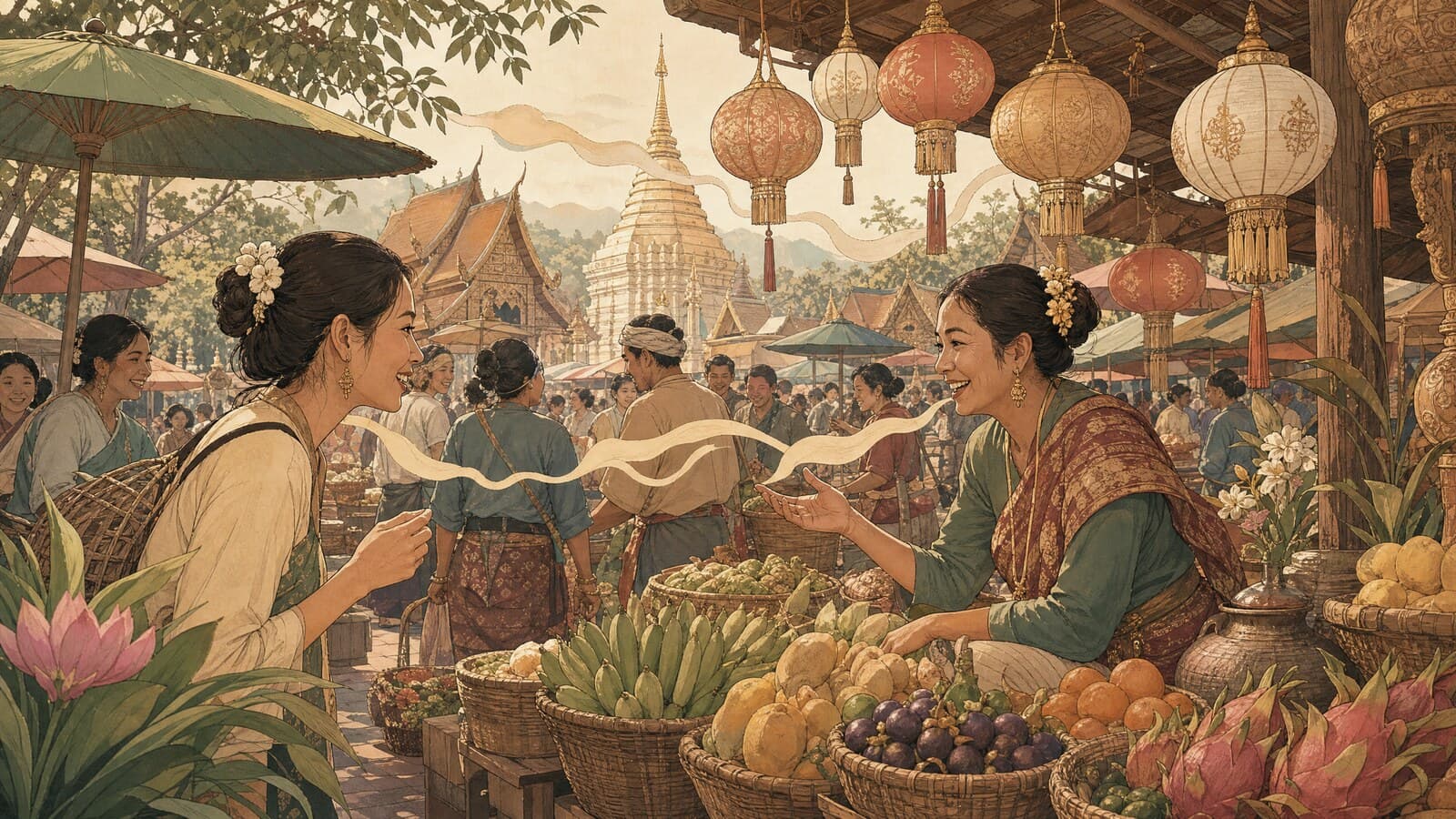
Spend a morning at any Chiang Mai market and you'll notice it: the Thai floating around you doesn't quite match the Thai in your phrasebook. Vowels stretch and soften, sentences land on a gentle chao instead of kha, and every so often an exchange dissolves into laughter you can't quite follow. You're not imagining it, and your phrasebook isn't wrong. You're hearing kham mueang — the language of the north — and it's one of the loveliest sounds this city makes.
Not an accent — a language of its own
Let's clear this up first: kham mueang is not Central Thai spoken with a northern lilt. Northern Thai is a language in its own right, with roughly six million speakers across the upper provinces and a smaller community over the border in north-western Laos. Linguists place it in the Tai family alongside Central Thai, Lao and Tai Lue — close cousins that shade into one another in a great dialect continuum, so a Chiang Mai grandmother and a Luang Prabang boatman can often find their way to mutual understanding. The name tells you everything about where its heart lies: kham mueang means "the language of the mueang" — the towns of the northern valleys — and its speakers call themselves khon mueang, people of the mueang.
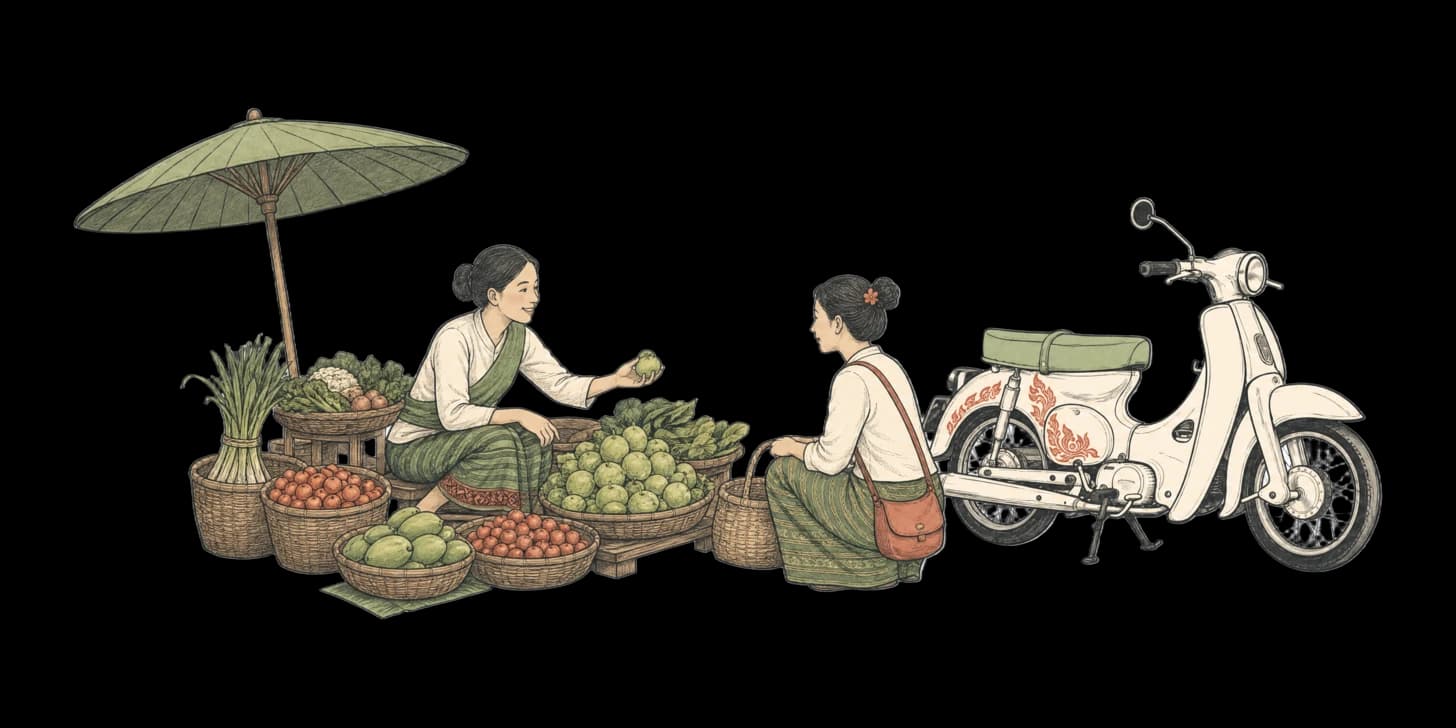
Born in the Lanna kingdom
Kham mueang grew up as the language of Lanna, the "kingdom of a million rice fields" that King Mangrai anchored at Chiang Mai in 1296 — a story we've told properly in our guide to the rise and fall of the Lanna kingdom. For centuries it was the language of court, trade and scripture here, and it came with its own rounded, looping alphabet, tua mueang, the Lanna script, in which the north's chronicles and Buddhist manuscripts were written. Central Thai arrived as the language of administration much later; the speech of the north was never a countrified copy of Bangkok's — it was here first, doing perfectly well on its own.
Words you'll actually hear this week
You don't need a linguistics degree to enjoy kham mueang. A handful of words surface constantly around Chiang Mai:
- Chao (เจ้า) — the north's signature politeness particle, used mostly by women where Central Thai uses kha, and doubling as a soft, warm "yes". A "sawasdee chao" with a smile is about as Chiang Mai as a greeting gets.
- Sao (ซาว) — twenty. Central Thai says yi-sip; the north (like Lao across the Mekong) says sao. Listen for it when market prices are flying.
- Muan (ม่วน) — fun, pleasant, a good time; the northern cousin of sanuk, and a word the north shares with Isan and Laos. If an evening was muan, it went well.
- Lam (ลำ) — delicious, the northern aroi. Say lam khanat — "properly delicious" — after a bowl of khao soi and watch what happens.
- U kam mueang (อู้กำเมือง) — to speak northern Thai; u is the northern word for "speak". Now you can name the very thing you're hearing.
Two languages, one city
So how do kham mueang and Central Thai share a city? Comfortably, but not equally. Since the Compulsory Education Act of 1921, schooling across Thailand has been in Central Thai only, so every northerner grows up fully bilingual: standard Thai for the classroom, the bank and the news; kham mueang for home, the market and the temple fair. In practice most city conversations weave between the two mid-sentence, and younger speakers often carry the melody and a fistful of northern words on an otherwise Central Thai frame. The old script fared worse — most northerners today can't read tua mueang — but the tide has been turning: universities teach the language and script, temple signboards wear the old letters again, and plenty of young Chiang Mai residents now treat kham mueang as a badge of identity rather than an embarrassment.
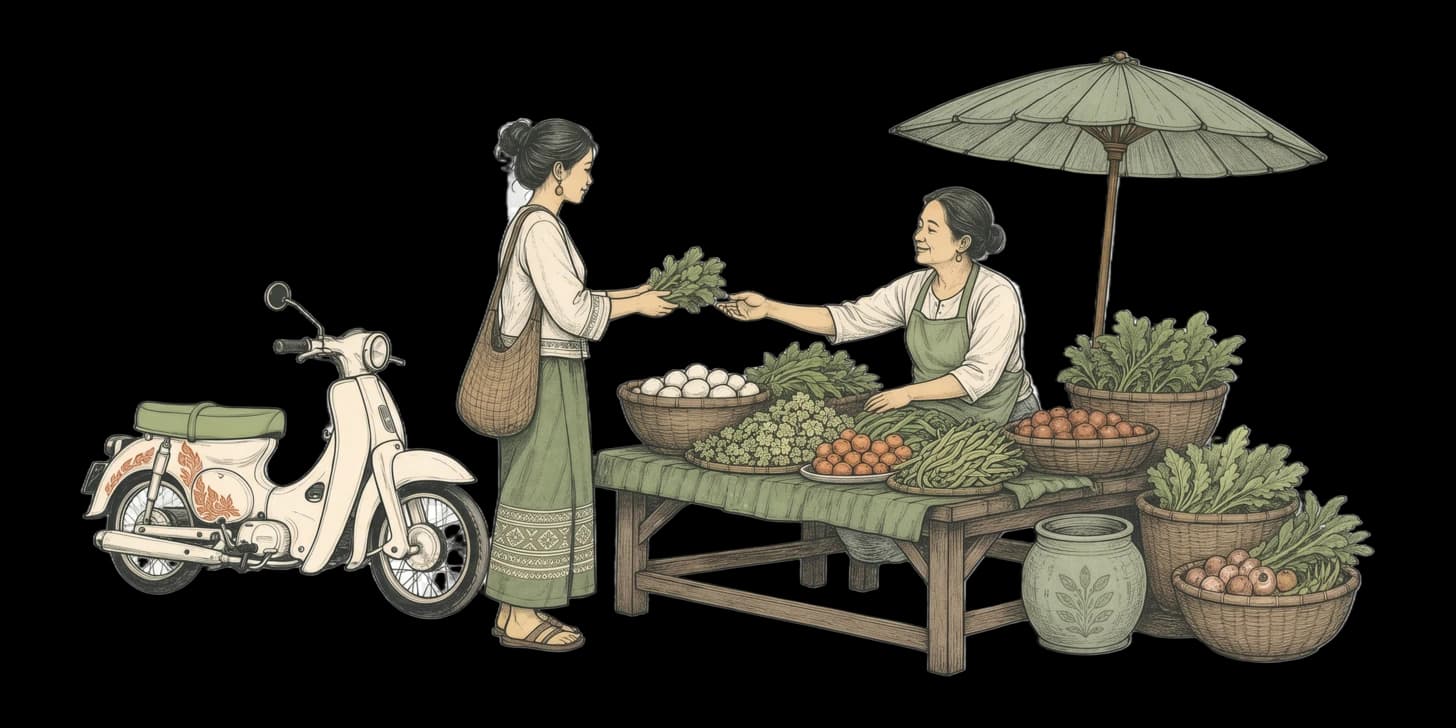
Why one little word earns such a big smile
Here's the part we love. Visitors who attempt Thai in Chiang Mai are met warmly; visitors who drop a single word of kham mueang are met with delight. A chao in reply to a vendor, a lam khanat after dinner — these earn you the kind of beaming double-take usually reserved for long-lost relatives. The reason is simple: kham mueang isn't a curiosity, it's an identity. For generations it was treated as lesser — something to shed on the way to Bangkok — so a guest who bothers to learn even one word is saying your north is worth knowing. Much like getting someone's Thai nickname right, it signals that you see the person in front of you, not just the country around them.
Should you learn it?
Honest answer: learn Central Thai first. It works everywhere, every northerner speaks it, and the best ways to learn Thai in Chiang Mai — schools, tutors, patient street practice — all teach the standard language. Kham mueang is the seasoning, not the meal: sprinkle in a chao here and a muan there, and let the smiles tell you when you've got it right. At Ada House we've watched a single well-timed lam khanat turn a routine noodle stop into a ten-minute conversation and a free second helping. That, we'd argue, is language learning at its most muan.
Frequently asked questions
What is kham mueang?
Kham mueang is Northern Thai, the language of the old Lanna kingdom, still spoken by roughly six million people across northern Thailand and a smaller community in north-western Laos. The name means "the language of the mueang" — the towns of the northern valleys — and its speakers call themselves khon mueang.
Is kham mueang just a dialect or accent of Thai?
No — it's a language in its own right within the Tai family, a close cousin of Central Thai, Lao and Tai Lue rather than a regional accent. It was the language of court, trade and scripture in Lanna centuries before Central Thai arrived as the language of administration, and it historically had its own alphabet, the tua mueang script.
What does "chao" mean in Chiang Mai?
Chao (เจ้า) is the north's signature politeness particle, used mostly by women where Central Thai uses kha, and it doubles as a soft, warm "yes". You'll hear it constantly in greetings like "sawasdee chao".
How do you say "delicious" in northern Thai?
The northern word is lam (ลำ), where Central Thai says aroi. For emphasis, lam khanat means "properly delicious" — say it after a bowl of khao soi and you'll usually be rewarded with a beaming smile.
Do people in Chiang Mai still speak kham mueang, or has Central Thai taken over?
Both live side by side. Since the Compulsory Education Act of 1921, schooling has been in Central Thai only, so northerners grow up bilingual: standard Thai for school, banks and officialdom, kham mueang at home and in the markets, with plenty of mid-sentence switching. Universities now teach the language and script, and many younger residents treat kham mueang as a badge of Lanna identity.
Should visitors learn kham mueang or Central Thai?
Learn Central Thai first — it works everywhere and every northerner speaks it. Treat kham mueang as the seasoning rather than the meal: sprinkling in a chao, a muan or a lam khanat is easy, and locals light up when a visitor makes even that small effort.