Local culture · June 27, 2026
The lost alphabet of the North: Chiang Mai's curly Lanna script
By The Ada House team
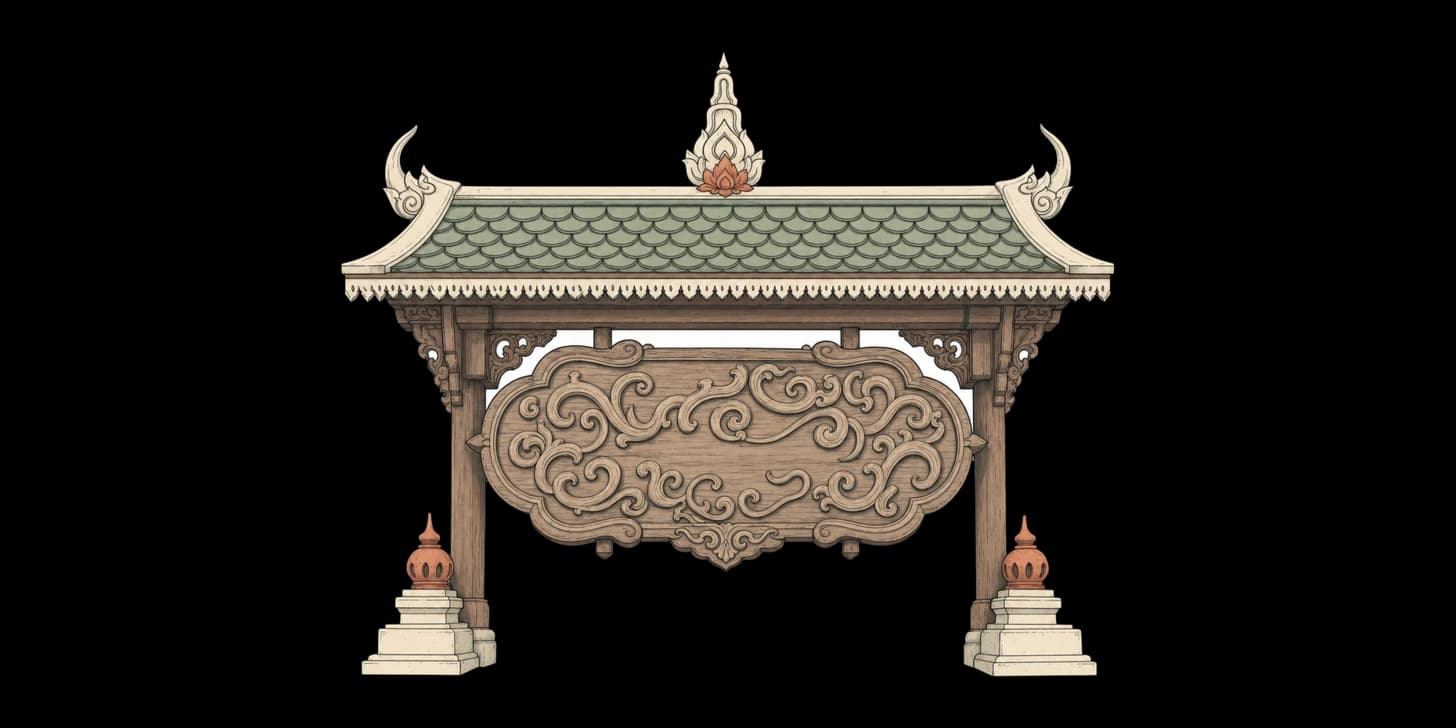
Some of our favourite mornings begin the same way: a slow wander through the old town, coffee in hand, eyes drifting up to a temple gable. And almost every time, a guest will pause, point at a weathered wooden sign, and ask the same lovely question — is that Thai? The honest answer surprises nearly everyone. No. Those rounded, looping characters, curling like incense smoke across the board, are not modern Thai at all.
A script hiding in plain sight
The letters are Lanna script, the old alphabet of the North, and here is the part that catches people off guard: most of the Thai people walking past cannot read a word of it either. It is a writing system that lives all around the city, yet stays quietly out of focus — present on signboards and amulets, but legible to only a devoted few. Once you know it is there, you start seeing it everywhere, and the old town gains a whole second layer of meaning.
Not Thai, but Tua Mueang
Locally the script is called Tua Mueang — roughly, the letters of our land — a twin to Kam Mueang, the spoken Northern Thai dialect you still hear in the markets. To scholars it goes by another name, Tai Tham, and it once carried not only Northern Thai but neighbouring tongues such as Tai Lue and Khun across the highlands. For centuries, when this was the independent kingdom whose story we trace in our piece on the rise and fall of the Lanna kingdom, Tua Mueang was simply how the North wrote. Letters, law, love poems, horoscopes and prayers all flowed in those gentle curves.
Letters born of palm and ink
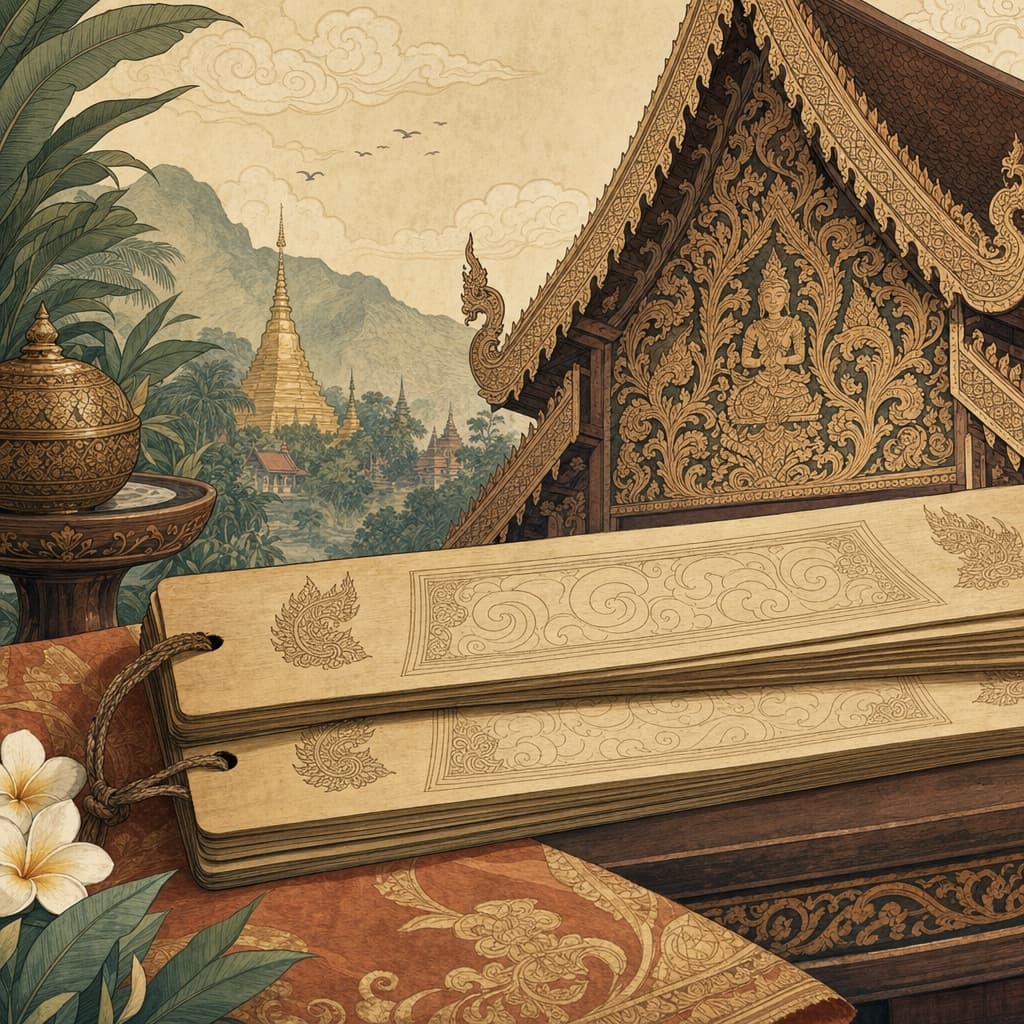
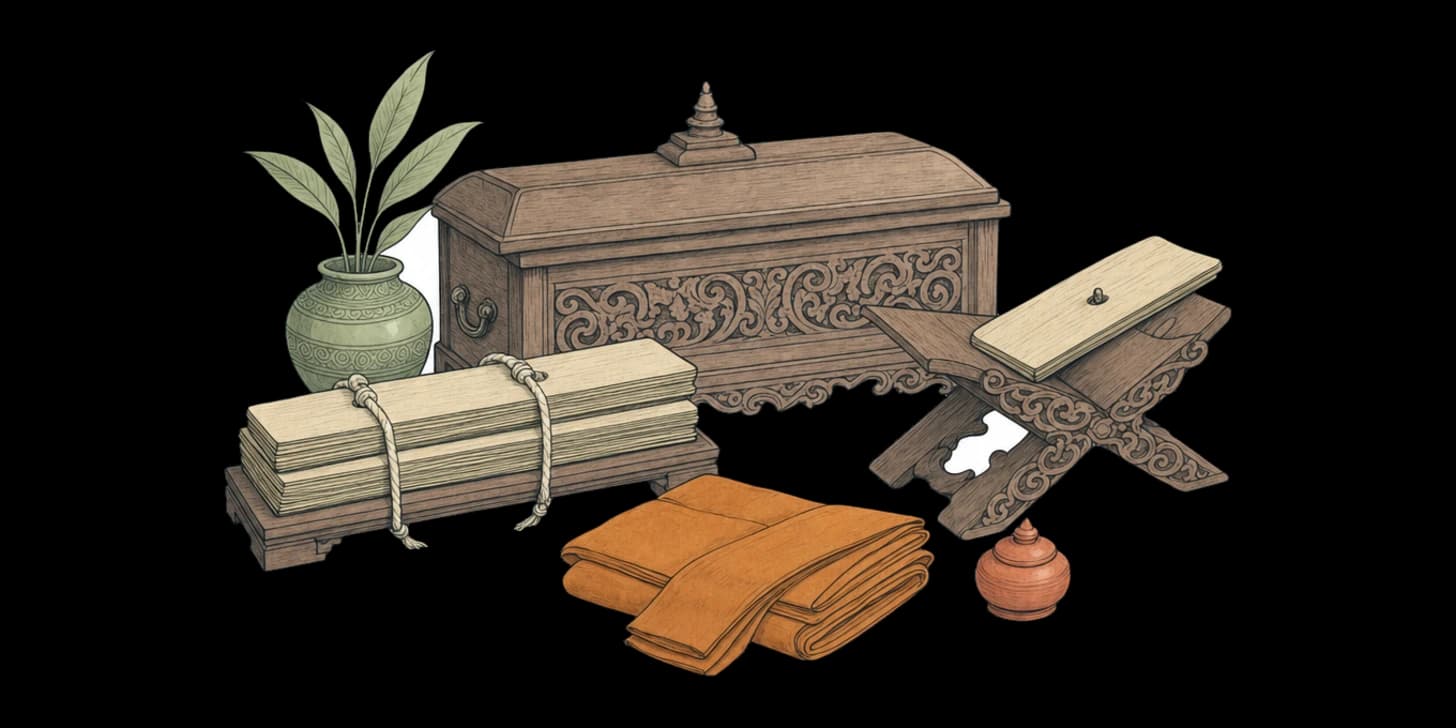
The roundness is not decorative whimsy — it is the fingerprint of the page itself. The North's great libraries were palm-leaf manuscripts: long strips of dried, treated leaf, bound between wooden covers and stored in lacquered cabinets in temple halls. A straight, angular stroke would split the grain of a leaf; a curved one rides along it. So the script learned to loop and roll. Scribes incised each letter with a stylus, then rubbed soot into the cuts to make them sing black against the pale leaf — thousands of pages, copied by hand, generation after generation.
A script for the dhamma
Tua Mueang has a more formal sibling, the Tham script — tham from dhamma, the teachings of the Buddha. This was the hand reserved for sacred work: Pali scripture, sermons, the great cosmological texts. To read Tham was a mark of real learning, and the monasteries were its universities. Much of what we know of old Lanna medicine, astrology and folklore survives only because a monk, somewhere, thought it worth pressing into a leaf. You can still feel that hush of scholarship in the older temples of the old city, where painted murals and foundation stones whisper in letters few visitors recognise.
How an alphabet falls quiet
So what happened? In a word, centralisation. As Lanna was drawn fully into the modern Thai state through the early twentieth century, a single national language was chosen for school, government and print. By the late 1930s, standard central Thai had become the mandatory medium of education, and the looping local script slipped out of the classroom. Within a couple of generations it faded from daily life — not banned so much as quietly left behind. Today the great majority of Northerners speak Kam Mueang warmly but cannot read the alphabet their great-grandparents used every day. There is a genuine wistfulness in that: a beautiful handwriting gone half-silent.
Where you can still spot it
And yet it never fully vanished. Once your eye is trained, Tua Mueang appears everywhere. It graces the name boards of temples and the lintels of old teak houses. It is inked into protective amulets and tattoos — the sacred yantra designs many believe carry real power precisely because they are written in this old, holy hand. It sleeps in glass cases in the city's museums, whole libraries of palm-leaf books waiting to be read. Learning even to sound out a few letters changes how the city looks, and pairs wonderfully with picking up a little of the spoken language — something we cheer on in our notes on learning Thai in Chiang Mai.
A gentle revival
Here is the heartening part. Tua Mueang is being lovingly coaxed back to life. Northern universities teach it; monks still train novices to read the Tham scriptures; enthusiasts have built digital fonts and apps so anyone can type those curls on a phone. Across the region, new road and place signs now carry the Lanna spelling above the Thai — a small civic act of remembering. It will likely never again be how the North writes its shopping lists, but as a thread of identity it is being knotted firmly back into place.
So next time you stand before a temple gate here, look up and look closely. That curl of letters is the North speaking in its own old voice — and, slowly, learning to read itself again.
From all of us at the Ada House team, may your eyes wander up a little more often.
Frequently asked questions
Is the curly script on old temple signs just Thai?
No, and the answer surprises nearly everyone. Those rounded, looping characters are Lanna script, the old alphabet of the North, and most of the Thai people walking past cannot read a word of it either. It lives all around the city on signboards and amulets, yet is legible to only a devoted few.
What is the script called?
Locally it is called Tua Mueang, roughly the letters of our land, a twin to Kam Mueang, the spoken Northern Thai dialect you still hear in the markets. To scholars it goes by another name, Tai Tham, and it once carried not only Northern Thai but neighbouring tongues such as Tai Lue and Khun across the highlands.
Why are the letters so round?
The roundness is the fingerprint of the page itself. The North's great libraries were palm-leaf manuscripts, long strips of dried, treated leaf bound between wooden covers. A straight, angular stroke would split the grain of a leaf, while a curved one rides along it, so the script learned to loop and roll. Scribes incised each letter with a stylus, then rubbed soot into the cuts to make them sing black against the pale leaf.
Why did the script fall out of everyday use?
In a word, centralisation. As Lanna was drawn fully into the modern Thai state through the early twentieth century, a single national language was chosen for school, government and print. By the late 1930s standard central Thai had become the mandatory medium of education, and the looping local script slipped out of the classroom, fading from daily life within a couple of generations.
Where can I still spot Tua Mueang today?
Once your eye is trained it appears everywhere: on the name boards of temples and the lintels of old teak houses, inked into protective amulets and sacred yantra tattoos, and sleeping in glass cases of palm-leaf books in the city's museums. It is also being lovingly revived, with northern universities teaching it, monks training novices to read the Tham scriptures, and new signs carrying the Lanna spelling above the Thai.