Local culture · June 24, 2026
Saturday Walking Street: Chiang Mai's silver quarter
By The Ada House team
Everyone tells you about the Sunday market. Almost nobody mentions that the night before, just south of the old city, Wualai Road closes to traffic and does its own thing. The Saturday Walking Street is smaller, more local, and quietly one of our favourite evenings in Chiang Mai — and it sits in the city's historic silversmiths' quarter, which gives it a character all its own.
Where it is, and why Wualai
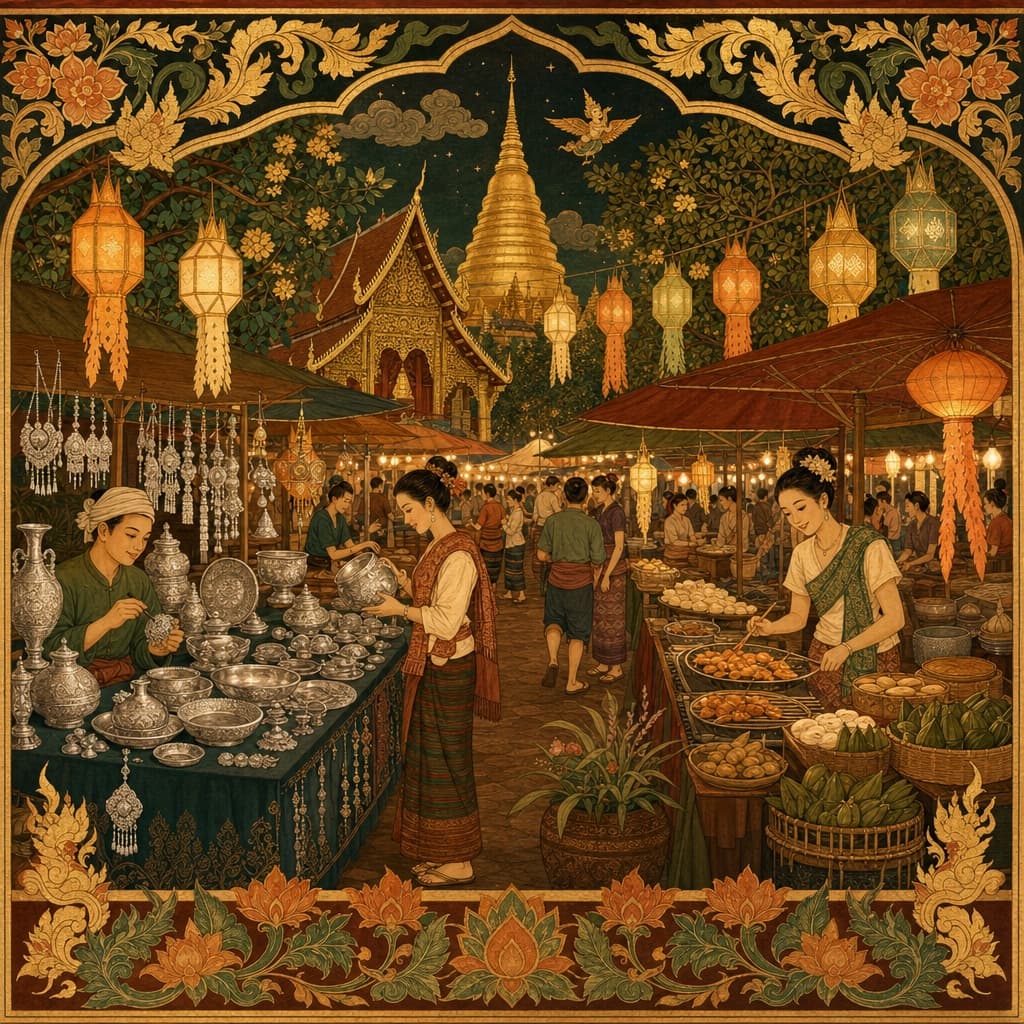
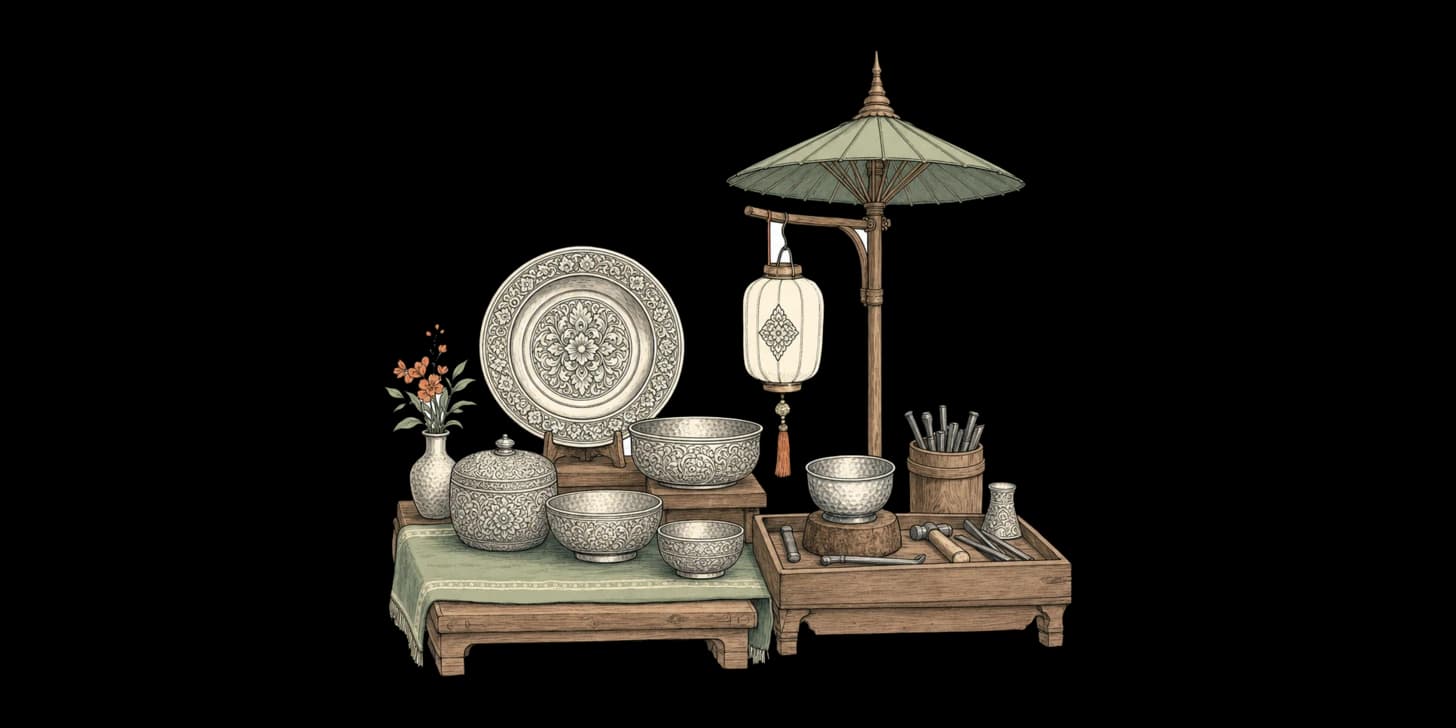
The market runs the length of Wualai Road (sometimes spelled Wua Lai), starting just across the moat at the southern edge of the old city and stretching south for the better part of a kilometre. This is the old silver-making district, and it has been for generations — you'll still spot a few working silversmiths' workshops tucked between the stalls, the tap-tap of hammers on metal still going as the crowd flows past.
That heritage shapes the whole market. Where the Sunday street is a sprawling everything-market, Saturday leans into silver, handicrafts and textiles, sold by the people who actually make them. If you want to understand the craft behind it first, our guide to Lanna handicrafts is a good primer.
How it differs from the Sunday street
The honest short version: the Saturday Walking Street is smaller, narrower and less overwhelming than its famous Sunday counterpart. Fewer stalls, fewer tour groups, more room to actually walk rather than shuffle. It feels more like a neighbourhood out enjoying itself than a tourist event.
That makes the choice easy. If you only have one evening, the Sunday street is the bigger spectacle. But if crowds tire you, or you specifically want silver and quality crafts, Saturday wins. And if you're staying with us a while — many of our guests do both, and the contrast is half the fun. Either way, it's a different beast from the city's permanent night markets, which run every evening and lean more commercial.
What to eat and what to buy
Come hungry. The food here skews properly Northern Thai — look for sai ua (the herby Chiang Mai sausage), grilled skewers, sticky rice, and sweet things like coconut pancakes and mango with sticky rice. There's usually a little sit-down food court around the Soi 3 section if you'd rather sit than graze on your feet. It's a fine, low-key way into Northern Thai food if you're still finding your feet with it.
For buying, this is the market for silver — earrings, rings, pendants, small homewares — alongside woven textiles, ceramics and the usual run of clothes and souvenirs. Prices are gentle, a little polite bargaining is fine, and you'll want cash: most stalls don't take cards, so bring small notes.
Don't miss the silver temple
While you're here, walk a little way down Wualai to Wat Sri Suphan, the famous silver temple. Its ordination hall is clad almost entirely in hand-beaten silver and aluminium, and on Saturday evenings it's lit up to glow against the dark — genuinely striking, and free to admire from outside. (Note that the inner hall is traditionally open to men only, though the grounds are for everyone.) It's one of the more unusual stops on any tour of the old city's temples.
Timing and getting there
Stalls set up from around 5pm and the market runs until roughly 10.30pm; arrive around 6pm for the sweet spot, when everything's open but the crush hasn't peaked. It's an easy walk from much of the old city, or a quick songthaew (red truck) hop — flag one down, agree the fare first, and you're there in minutes. Our notes on getting around Chiang Mai cover the songthaew etiquette if you're new to it. On the walk you'll likely pass a few dozing soi dogs along the quieter lanes; our guide to coexisting kindly with Chiang Mai's soi dogs is worth a read before you wander.
One last thing: don't try to see all of it. The Saturday street rewards the slow wander far more than the brisk lap. Pick up a stick of sai ua, drift past the silver stalls, double back when something catches your eye, and let the temple lights pull you down the road. That's the whole pleasure of it.
Go slowly, eat as you wander, and let the hammering of the silversmiths set the pace. We'll see you out there.
Frequently asked questions
Where is the Saturday Walking Street?
It runs the length of Wualai Road (sometimes spelled Wua Lai), starting just across the moat at the southern edge of the old city and stretching south for the better part of a kilometre. This is the old silver-making district, and you'll still spot a few working silversmiths' workshops tucked between the stalls.
How is it different from the Sunday market?
The Saturday street is smaller, narrower and less overwhelming than the famous Sunday one, with fewer stalls and fewer tour groups, so there's more room to actually walk. It leans into silver, handicrafts and textiles sold by the people who make them, and it feels more like a neighbourhood out enjoying itself than a tourist event.
What should I eat there?
The food skews properly Northern Thai. Look for sai ua (the herby Chiang Mai sausage), grilled skewers, sticky rice, and sweet things like coconut pancakes and mango with sticky rice. There's usually a little sit-down food court around the Soi 3 section if you'd rather sit than graze on your feet.
What is good to buy, and should I bring cash?
This is the market for silver, including earrings, rings, pendants and small homewares, alongside woven textiles, ceramics and the usual clothes and souvenirs. Prices are gentle and a little polite bargaining is fine, but bring cash in small notes, as most stalls don't take cards.
What are the opening times?
Stalls set up from around 5pm and the market runs until roughly 10.30pm. We'd suggest arriving around 6pm for the sweet spot, when everything's open but the crush hasn't peaked.
Is there anything special to see nearby?
Yes. Walk a little way down Wualai to Wat Sri Suphan, the famous silver temple, whose ordination hall is clad almost entirely in hand-beaten silver and aluminium. On Saturday evenings it's lit up against the dark and is free to admire from outside. Note that the inner hall is traditionally open to men only, though the grounds are for everyone.