Local culture · June 25, 2026
Wat Ban Den: Chiang Mai's most dazzling temple, an hour north
By The Ada House team
You think you've seen Chiang Mai's temples. Then you turn off the highway near Mae Taeng, the trees part, and an entire hillside of gold and white spires spreads out in front of you. This is Wat Ban Den — the grandest temple in the region, and the one almost nobody tells you about.
What makes it different
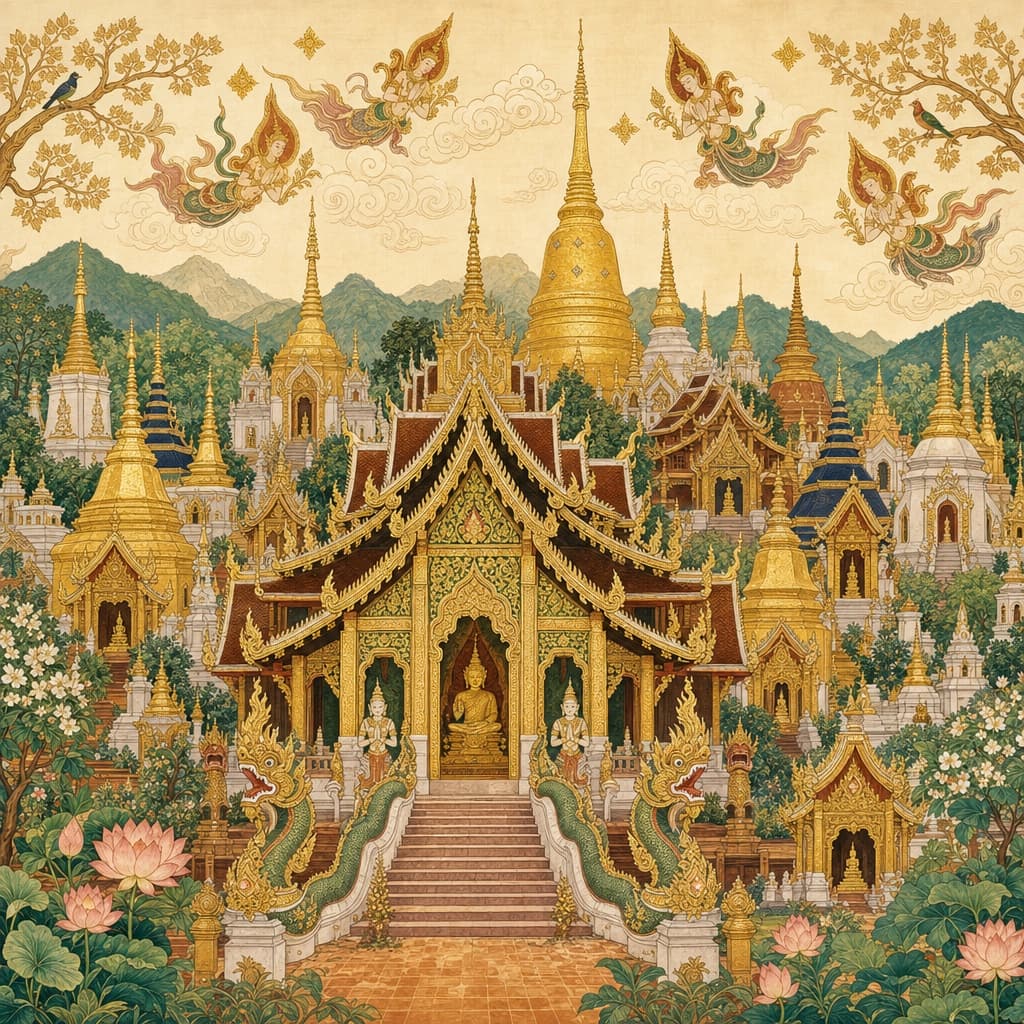
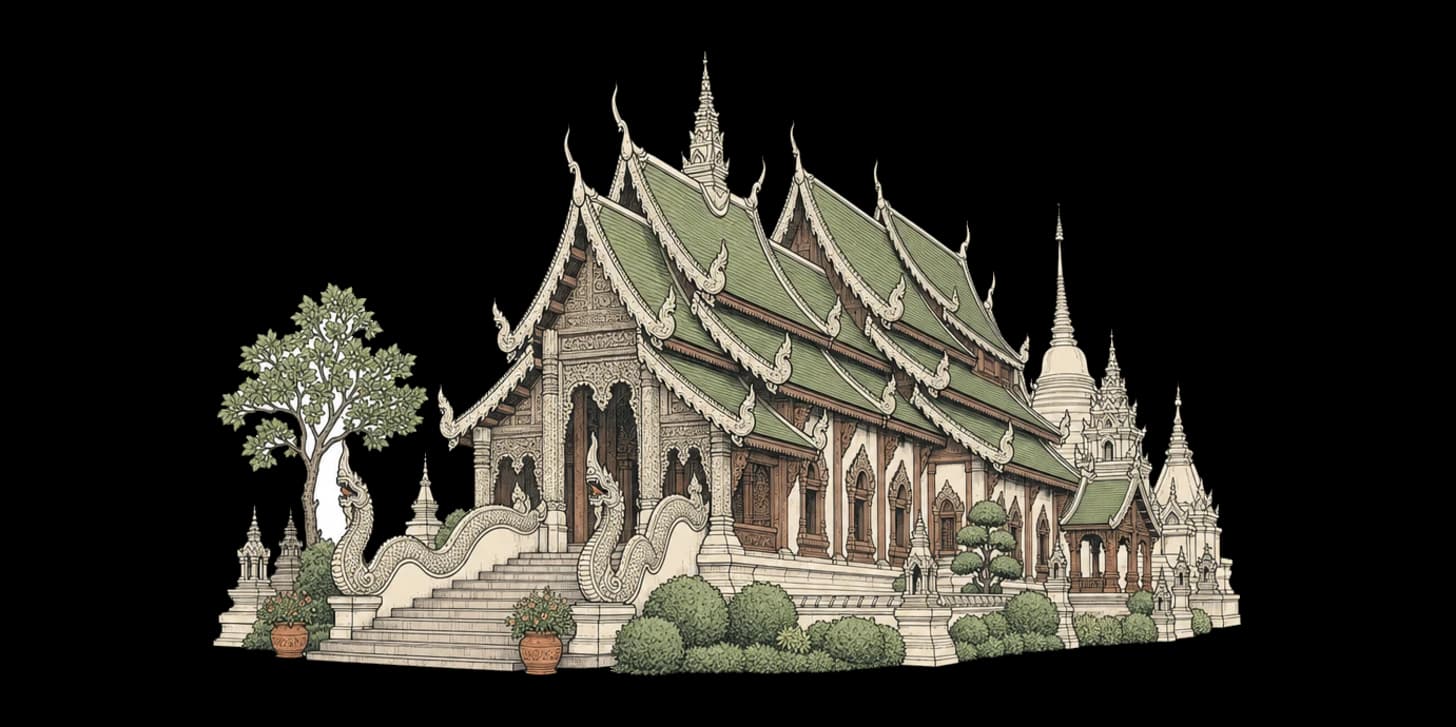
Most of the temples you'll visit in town earn their awe through age. Wat Ban Den does the opposite. Officially Wat Den Salee Sri Muang Gan, it grew from a humble village shrine into something staggering: a whole compound of richly decorated Lanna-style viharns, each one a riot of carved teak, gilded eaves and mirrored glasswork, all built in the last century and still being added to.
The effect is Lanna craft turned up to maximum — ornate, vast, unapologetically golden. Where the old-city temples whisper centuries of patina, Wat Ban Den sings at full volume. Dragon-flanked naga staircases climb between the halls, their serpent bodies rippling down each flight, and white spires catch the light from every angle. It's the same artistic tradition you'll read about in the Lanna kingdom's history, alive and maximalist rather than preserved behind glass.
Give yourself time to wander. Each viharn has its own character — one all crimson and gold inside, another cool and white, a third opening onto a courtyard you didn't expect. There's no single must-see hall and no rush; the pleasure is simply drifting from one to the next, looking up at the painted ceilings, and letting the scale of the place sink in slowly.
The twelve zodiac pagodas
The detail everyone remembers is the row of twelve pagodas, one for each animal of the Chinese zodiac. Thai pilgrims come specifically to honour the chedi of their birth year — finding the dragon or the rooster or the ox, leaving an offering, and pausing for a quiet moment that belongs to them alone.
Wander among them and you'll see families tracing their years from pagoda to pagoda, children sounding out the animals. Ask a local which one is theirs and you'll usually get a warm story in return. Find your own birth-year animal before you go; standing at your pagoda is a small, lovely ritual that makes the whole place feel personal.
Why so few foreigners reach it
Here's the quiet magic of Wat Ban Den: it sits about an hour north of the city, just far enough that the big tour circuits skip it. So instead of jostling crowds, you'll mostly share the grounds with Thai pilgrims — families picnicking, monks crossing the courtyards, the unhurried rhythm of a working temple rather than a photo stop.
That distance is the whole point. It keeps the place real, and it makes the gold feel like a reward for going looking.
How to visit
It's roughly 45 to 50 kilometres north toward Mae Taeng, about an hour by car or scooter. If you're confident on two wheels it's a gorgeous ride out through rice country; if you'd rather someone else drove, the options for getting around Chiang Mai all work. There's no direct bus, so a hired car or red songthaew is the simplest choice without your own wheels.
Entry is free — a donation is welcome and well earned. Dress modestly, with shoulders and knees covered, as you would at any active temple. Go in the morning while the light is soft and the heat is kind.
Best of all, Wat Ban Den pairs perfectly with the rest of the area. The serene reservoir at Mae Ngat dam is close enough to fold into the same trip, and an ethical elephant sanctuary in the valley makes for a full, satisfying day out. If you've already done the classic Doi Suthep weekend, this is the natural next step — the temple that proves Lanna artistry never stopped evolving.
Go north. Take your time. We promise the gold is worth the drive.
— The Ada House team
Frequently asked questions
Where is Wat Ban Den and how far is it?
It lies near Mae Taeng, roughly 45 to 50 kilometres north of the city, about an hour by car or scooter. Its official name is Wat Den Salee Sri Muang Gan.
How do I get there without my own transport?
There is no direct bus, so a hired car or a red songthaew is the simplest choice. If you are confident on two wheels, it is a gorgeous ride out through rice country.
What are the twelve zodiac pagodas?
They are a row of twelve pagodas, one for each animal of the Chinese zodiac. Thai pilgrims come to honour the chedi of their birth year, leaving an offering and pausing for a quiet moment, so finding your own birth-year animal is a small, lovely ritual.
Why do so few foreign visitors reach it?
It sits just far enough north that the big tour circuits skip it. So instead of jostling crowds, you will mostly share the grounds with Thai pilgrims and the unhurried rhythm of a working temple rather than a photo stop.
Is there an entrance fee and a dress code?
Entry is free, though a donation is welcome and well earned. Dress modestly with shoulders and knees covered, as you would at any active temple.
When is the best time to visit?
Go in the morning while the light is soft and the heat is kind. It also pairs perfectly with the nearby Mae Ngat dam reservoir to fold into a full day out.