
Local culture · July 5, 2026
Thai tones explained without tears
By The Ada House team
At some point in your first week in Chiang Mai, you will say a Thai word exactly as you heard it, and receive a look of polite, total incomprehension. You said the sounds. You did not say the tune. Thai is a tonal language, and the tune is not decoration — it is the word. Here is how it works, why your English-trained brain fights it, and why none of this should put you off.
One syllable, five words
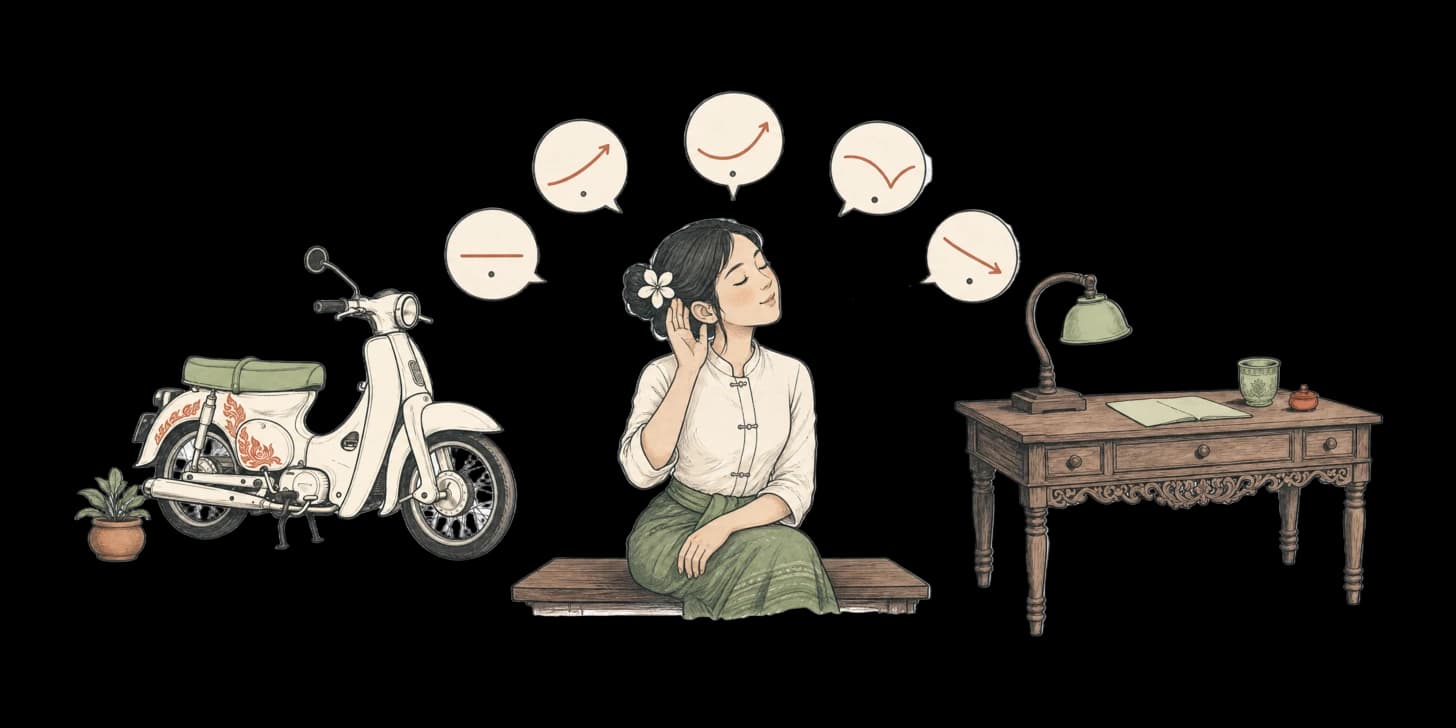
Thai has five tones: mid, low, falling, high and rising, and each one turns the same syllable into a different word. Not a different shade of feeling — a different dictionary entry. Take maa: said flat and level (mid tone), it means come. Pitched high (máa), it means horse. Swooping upwards (mǎa), it means dog. So máa maa is "the horse is coming" and mǎa maa is "the dog is coming", and if you get it muddled the animal changes species mid-sentence. This is why Thai sounds so musical to newcomers: every syllable carries a little melody, and the melody is doing grammatical heavy lifting.
The sentence about wood that will not burn
Every Thai person knows the party trick: ไม้ใหม่ไม่ไหม้ไหม — mái mài mâi mâi mǎi — five syllables that all sound like "mai" to an untrained ear, yet mean "New wood doesn't burn, does it?" Word by word: mái (high tone) is wood, mài (low) is new, mâi (falling) is not, mâi (falling again) is to burn, and mǎi (rising) is the question particle. To a Thai speaker these are five plainly different words; to the rest of us it is a man saying "mai" five times with increasing confidence. Say it to a Thai friend and watch their face light up — it is the national tongue twister, and attempting it earns you instant goodwill.
The words that will ambush you
Some minimal pairs seem designed by a committee of pranksters. The khao family: khâao (falling tone) is rice, khǎao (rising) is white, khàao (low) is news, and khâo (falling, but clipped shorter) is to enter — so one mis-pitched vowel and your dinner order becomes a colour, a headline or a door. The suea trio: sǔea (rising) is tiger, sûea (falling) is shirt, sùea (low) is a woven mat — which is how people end up asking a night-market stallholder for a tiger in size medium. And the cruellest of all: klai (mid tone) means far, while klâi (falling) means near. Yes. The words for near and far are the same syllable, one tone apart, and you will discover this while asking for directions.
Why your English brain fights you
English uses pitch too — but for emotion and grammar, never for vocabulary. We rise at the end of a question, drop when we're bored, leap about when we're excited, and the words underneath stay the same. That habit is precisely the problem. Ask "khâao?" with a helpful English question-rise and you have not asked "rice?" — you have said "white". Sound uncertain, and the wobble in your voice rewrites your sentence. Learning Thai tones is less about acquiring something new than about switching off a reflex you've had since infancy: in Thai, the pitch belongs to the word, and your feelings will have to find somewhere else to live.
How to actually hear them
Three things genuinely help. First, listen for the contour, not the note. A falling tone is a shape — high sliding to low — not a fixed pitch; a gravelly grandfather and a six-year-old produce wildly different frequencies but the same swoop. Second, mimic whole phrases like song lyrics rather than assembling words syllable by syllable. Your ear is far better at copying a melody than computing five tone rules mid-sentence, which is why phrases learned from real speech come out right while phrases built from a textbook come out flat (our survival kit of essential Thai phrases is designed to be learned exactly that way). Third, drill minimal pairs — any app that plays you khâao and khǎao back to back until you can tell them apart is worth its download, whichever one it is. Ten minutes a day quietly rewires you.
The kind laughter, and the good news
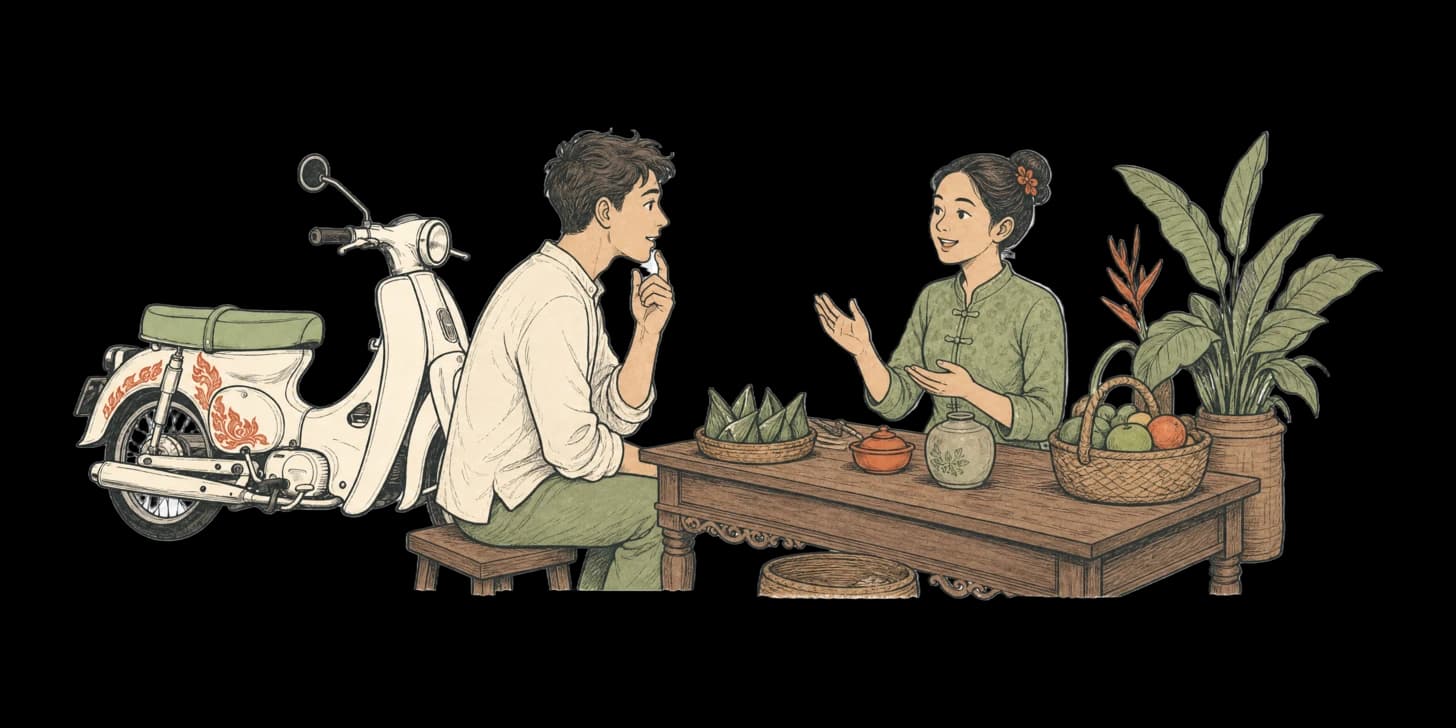
When your tones collapse, Thais will often laugh — and it is worth knowing that this is delight, not mockery. A foreigner gamely attempting the five tones is charming, in a country where half the population cheerfully answers to nicknames like Moo ("pig"), and where locals bend English into wonderful shapes of their own — Tinglish is a whole art form. Better still, context rescues you about ninety per cent of the time: nobody at a khao soi stall thinks you want white, and nobody at a clothing rail thinks you want a tiger. You do not need perfect tones to live happily in Chiang Mai. Eventually, though, you will want them — if only to stop asking whether the curry is far, whether the shirt bites, and whether there is horse in the fried rice. When that day comes, our guide to learning Thai in Chiang Mai will point you to the schools, apps and tutors who teach tones properly. Until then: say mái mài mâi mâi mǎi, accept the applause, and order the khao soi. It nearly always arrives as rice.
Frequently asked questions
How many tones does Thai have?
Thai has five tones: mid, low, falling, high and rising. Each tone turns the same syllable into a completely different word — it changes the meaning, not the mood. For example, maa said with a mid tone means "come", with a high tone it means "horse", and with a rising tone it means "dog".
What does the Thai tongue twister "mai mai mai mai mai" mean?
The famous sentence mái mài mâi mâi mǎi (ไม้ใหม่ไม่ไหม้ไหม) means "New wood doesn't burn, does it?" Word by word: mái (high tone) is wood, mài (low) is new, mâi (falling) is not, mâi (falling) is to burn, and mǎi (rising) is the question particle. It's the national party trick, and attempting it earns instant goodwill.
Do I need perfect tones to be understood in Chiang Mai?
No. Context rescues you about ninety per cent of the time — nobody at a khao soi stall thinks you're asking for the colour white, and nobody at a clothing rail thinks you want a tiger. You can live happily in Chiang Mai with imperfect tones, though you'll want to improve them eventually for trickier situations.
Why do English speakers find Thai tones so difficult?
English uses pitch for emotion and grammar rather than vocabulary — we rise at the end of questions, for instance. In Thai, pitch belongs to the word itself, so asking "khâao?" with an English question-rise accidentally turns "rice" into "white". Learning tones is largely about switching off that lifelong reflex.
What is the best way to learn to hear Thai tones?
Three things help: listen for the contour (the shape of the pitch, like a fall or a swoop) rather than the absolute note; mimic whole phrases like song lyrics instead of assembling syllables from rules; and drill minimal pairs with any app that plays similar words back to back until you can tell them apart. Ten minutes a day makes a real difference.
Which Thai words are most often confused because of tones?
The classics are khao — khâao (falling) is rice, khǎao (rising) is white, khàao (low) is news and khâo (falling, shorter) is to enter; the suea trio — sǔea (rising) tiger, sûea (falling) shirt, sùea (low) mat; maa — come, horse or dog; and the cruellest pair, klai (mid tone) meaning far versus klâi (falling) meaning near.