Practical tips · July 5, 2026
Essential Thai phrases for Chiang Mai: a survival kit that makes people smile
By The Ada House team
You don't need Thai to get by in Chiang Mai — English, gestures and a translation app will keep you fed, housed and driven around. But a dozen phrases change the temperature of every exchange. Vendors light up, prices soften, and somewhere between your third khop khun and your first aroi, the city stops treating you like a tourist and starts treating you like a guest. Consider this your courage kit: no script, no tone drills, just the words that make people smile.
Start with the politeness engine
Thai courtesy runs on two small words: khrap if you're a man, kha if you're a woman, added to the end of almost anything you say. They carry no meaning on their own — they simply make a sentence polite, and the particle follows your gender, not the listener's. Sawasdee khrap/kha is hello (it doubles as goodbye), and khop khun khrap/kha is thank you. You'll use both twenty times a day, and they alone will carry you surprisingly far.
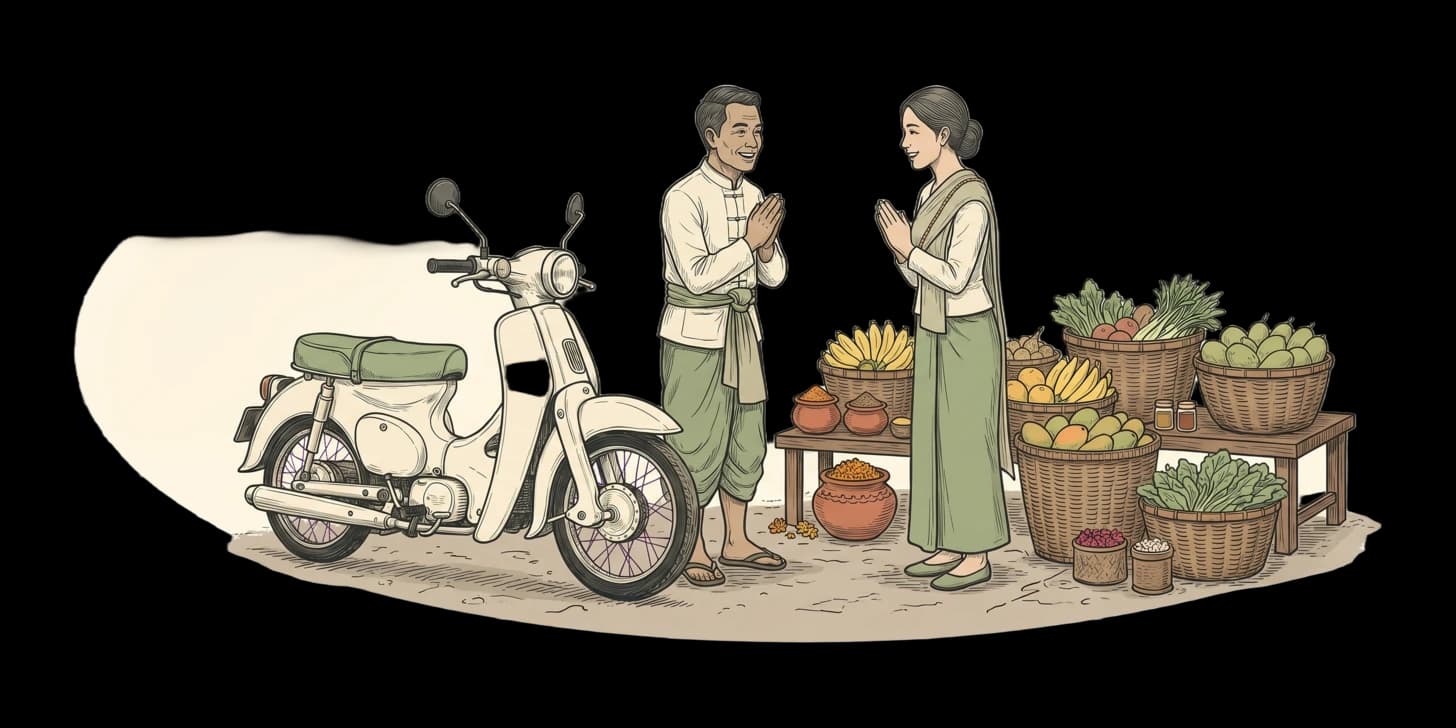
Then there's the wai — palms together, a slight bow. The simple rule: return a wai that's offered to you as a greeting, especially from your host, an elder or someone you're meeting properly. But don't feel obliged to wai the convenience-store cashier or a small child; a warm smile and a nod is exactly right, and over-waiing looks as odd as bowing to your barista back home. The finer points live in our guide to Thai etiquette — for now, smile and add the particle.
The golden dozen
If you learn nothing else, learn these — grouped by the moments you'll actually need them.
Courtesy: sawasdee (hello and goodbye), khop khun (thank you), khor thot (sorry, and excuse me — handy for squeezing through a market crowd).
Money: tao rai? (how much?), paeng pai! (too expensive — always said with a grin, never a scowl).
The table: aroi (delicious), mai phet (not spicy) or phet nit noi (just a little spicy), check bin — or the more local gep tang — for the bill.
Rescue: … yuu tii nai? (where is…?), mai khao jai (I don't understand), chai / mai chai (yes / no) and mai pen rai (never mind).
One honest note on yes and no: Thai conversation rarely delivers a flat no. Expect a softened "maybe", a "not yet" or a gentle change of subject — it's kindness, not evasion, and it works better if you play along.
Mai pen rai, the phrase that explains Thailand
Mai pen rai translates as "never mind" or "it's nothing", but it carries far more weight than that. It's the verbal shrug that keeps Thai life smooth: the response to your apology, to a spilled drink, to a downpour that cancels your plans. Say it when something small goes wrong and watch shoulders drop and smiles return. The one caveat — it's a grace you offer, not an excuse you hide behind. If you've genuinely inconvenienced someone, lead with khor thot first and let them be the one to wave it away.
Numbers that pay for themselves
Ten small words unlock every market in the city: neung, song, saam, sii, haa, hok, jet, paet, gao, sip — one through ten. Then yii-sip is twenty and neung roi is one hundred, which covers most street-food and songthaew arithmetic. Vendors will happily tap prices into a calculator for you, but quoting saam sip back at them earns a different kind of smile — and a paeng pai delivered with numbers and a grin is the opening move of every good-natured haggle. We've written more about when to bargain (and when not to) in our guide to tipping and bargaining in Thailand.
The food-ordering mini-kit
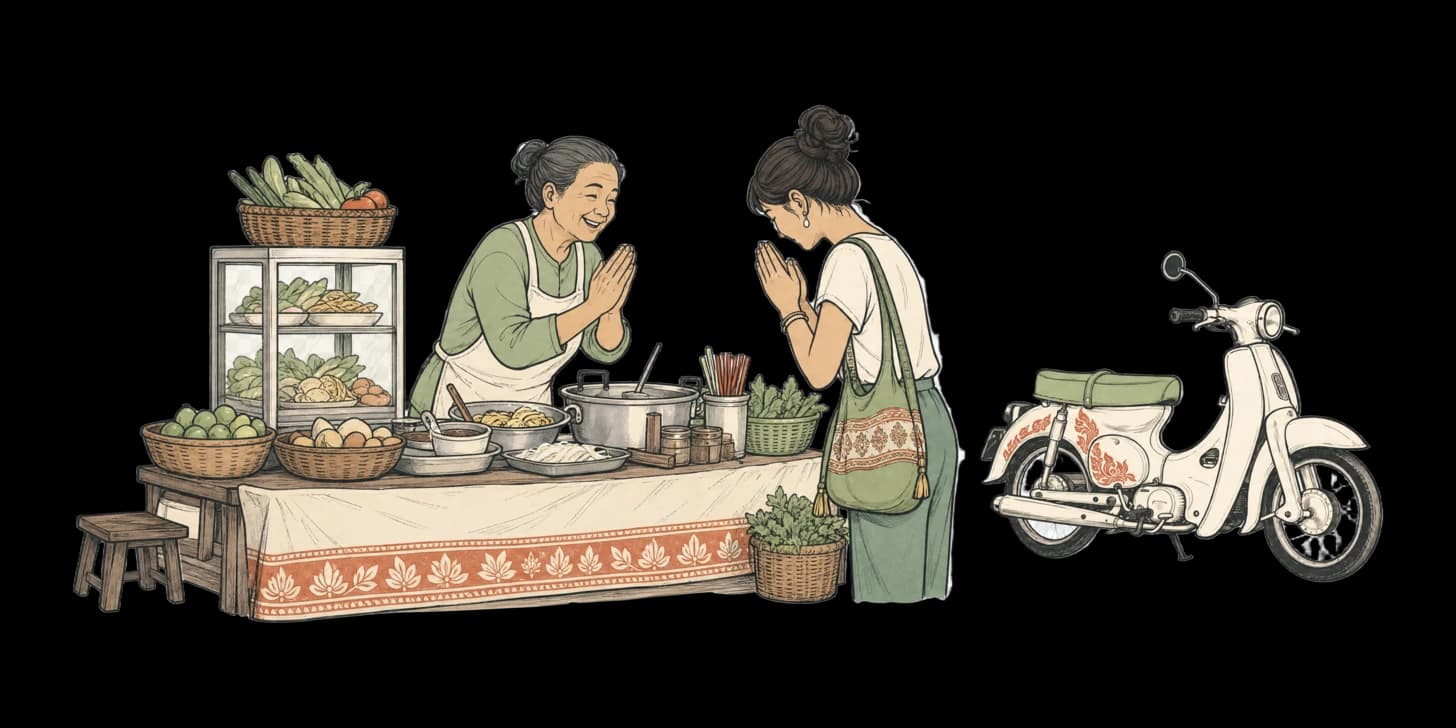
Two tiny words do enormous work at any food stall: sai (with, literally "put in") and mai sai (without). Mai sai phak chee — no coriander. Mai sai nam tan — no sugar. For anyone with allergies this pair is genuinely powerful: mai sai thua means no peanuts, though for a serious allergy we'd still pair it with a written Thai allergy card rather than trusting pronunciation alone. Order phet nit noi and know that the kitchen's "a little spicy" may still hum pleasantly. And when the khao soi is as good as it usually is, aroi mak — very delicious — will make the cook's evening.
An honest word about tones
Full disclosure: Thai has five tones, and the transliterations in this article are friendly approximations — the syllable written khao can mean rice, white, news or enter depending on pitch. Here's the good news: Chiang Mai's vendors and drivers are generous decoders. Context does the heavy lifting, and a wrong tone delivered with a right smile lands almost every time. Point-and-smile beats perfect grammar; effort beats accuracy. The decoding runs both directions, too — the delightful hybrid you'll hear coming back at you has a whole story of its own.
Your Chiang Mai bonus round
Listen closely at the market and you'll catch a softness the phrasebooks miss: jao (often written chao), the northern particle you'll hear in place of kha, especially from women — sawasdee jao is Chiang Mai distilled into two words. That's your first taste of kham mueang, the northern Lanna language with its own script and its own music; a story for another day. For now, ten phrases are enough — enough to be greeted differently, fed better and forgiven faster. Say them badly, say them with a smile, and doors will open. And when you're ready for more than survival, here's how to actually learn Thai in Chiang Mai. Sawasdee jao — we'll see you at the market.
Frequently asked questions
What are the most important Thai phrases to learn for Chiang Mai?
Start with the courtesy core: sawasdee (hello and goodbye), khop khun (thank you) and khor thot (sorry or excuse me), always ending with khrap if you're a man or kha if you're a woman. Add tao rai? (how much?), aroi (delicious), mai phet (not spicy), check bin (the bill, please), yuu tii nai? (where is...?), mai khao jai (I don't understand) and mai pen rai (never mind), and you have a genuine survival kit.
What is the difference between khrap and kha?
They are politeness particles added to the end of almost any sentence: men say khrap and women say kha. The particle follows the speaker's own gender, not the listener's. Neither word means anything on its own — it simply makes what you said polite.
When should I return a wai in Thailand?
Return a wai that's offered to you as a greeting, especially from your host, an elder or someone you're meeting properly. You don't need to wai convenience-store cashiers or small children — a warm smile and a nod is exactly right, and over-waiing can look odd.
Do I need to get the Thai tones right to be understood?
Not for everyday survival phrases. Thai has five tones and transliterations are only approximations, but vendors and drivers in Chiang Mai are generous decoders — context does the heavy lifting, and a wrong tone delivered with a smile lands almost every time. Effort beats accuracy, and pointing with a smile beats perfect grammar.
How do I order Thai food without certain ingredients?
Use sai (with) and mai sai (without): mai sai phak chee means no coriander and mai sai thua means no peanuts. Mai phet asks for not spicy and phet nit noi for just a little spicy. For a serious allergy, pair these phrases with a written Thai allergy card rather than relying on pronunciation alone.
What does mai pen rai mean?
It translates as 'never mind' or 'it's nothing', and it's the verbal shrug that keeps Thai life smooth — the standard response to an apology, a spilled drink or cancelled plans. Use it to let small mishaps go, but if you've genuinely inconvenienced someone, apologise with khor thot first and let them be the one to wave it away.