
Practical tips · July 5, 2026
Chiang Mai with limited mobility: an honest accessibility guide
By The Ada House team
If you use a wheelchair, or travel with someone who does, you deserve a straight answer rather than a brochure. So here it is: Chiang Mai was not built with wheels in mind, and parts of it will test your patience. But harder does not mean impossible — far from it. With honest expectations, a handful of tactics and the right bookings made in advance, this city gives back far more than it asks. This is what we would tell a friend.
First, the honest bit
The Old City is the hardest part. Pavements — where they exist — are a patchwork of uneven slabs, tree roots and surprisingly high kerbs, and what clear space remains is often claimed by parked scooters, food carts or the odd open drain. Dropped kerbs are rare and not always usable when you find them. In a manual chair, many streets mean rolling along the road edge with the (mercifully slow) traffic, and a companion will earn their dinner pushing over the rough stretches. We are not saying this to put you off. We are saying it so you can budget your energy, plan shorter outings, and treat the Old City as somewhere you dip into rather than roam for hours.
Let Grab do the legwork
The good news: you rarely need to cover distance on those pavements at all. Grab cars are inexpensive, air-conditioned and door to door, and most drivers will cheerfully stow a folded chair in the boot — a quick message once you have booked ("wheelchair, thank you!") smooths everything. The traditional options are less kind: songthaews and tuk-tuks both involve a high step up and little to hold on to, which some travellers manage and many sensibly skip. As far as we can tell, Chiang Mai has no wheelchair-adapted public transport, so build your days around private cars from the start. Our guide to getting around Chiang Mai covers every option in more detail.
Where the city simply works
Chiang Mai's big modern malls are genuinely easy: smooth floors, lifts to every level, accessible toilets and step-free entrances, plus blessed air-conditioning in the hot months. The MAYA and Central-style centres make reliable anchors for a low-effort afternoon of food courts and cinema. Modern hotels are the other bright spot — most recent, purpose-built properties offer accessible rooms. But "accessible" means wildly different things here, so book ahead and ask for photographs: the bathroom door width, roll-in shower versus bathtub, any step at the entrance. A good hotel sends photos without fuss — and hesitation is itself an answer.
Temples, triaged
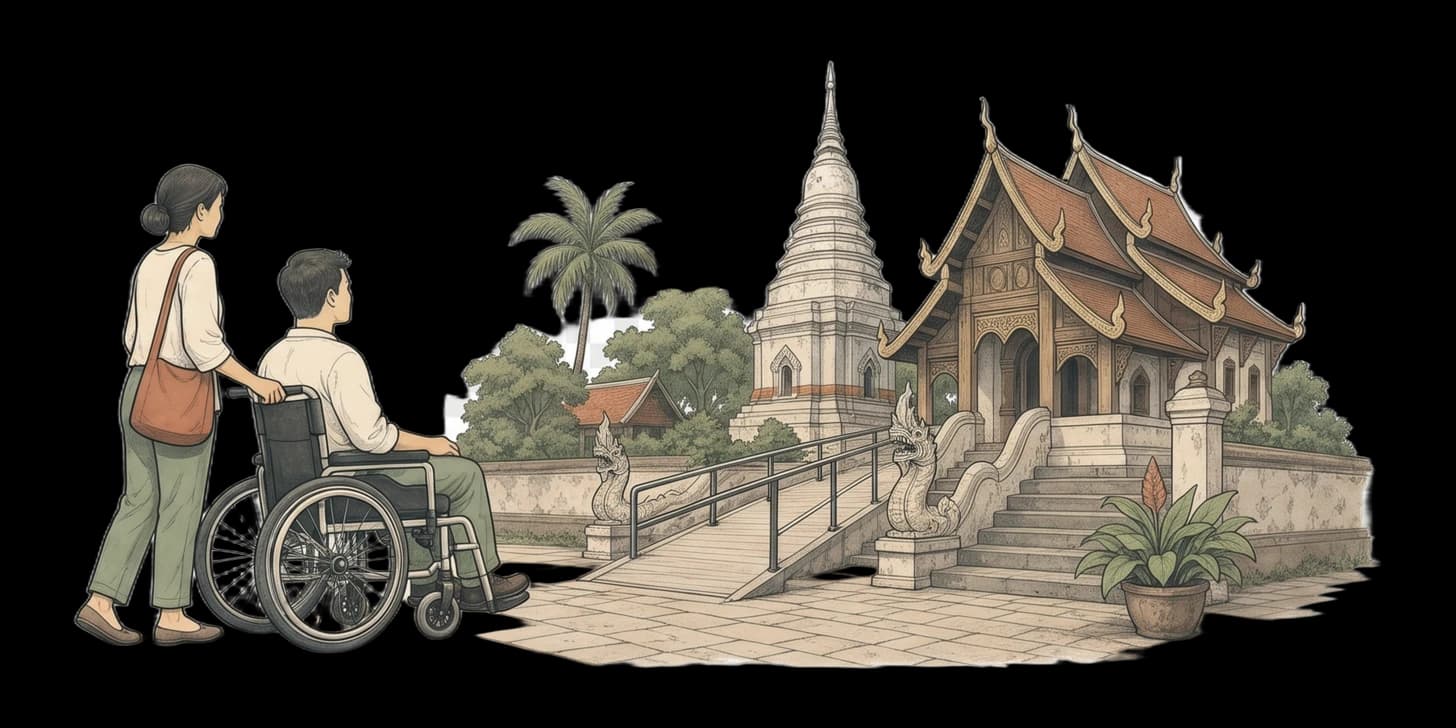
You do not have to skip the temples; you just have to choose well. Start with Wat Phra Singh: its broad compound is largely flat and paved, with room to move between the halls, though a few buildings still have steps at the threshold. It is comfortably the best temple experience on wheels in the Old City. Doi Suthep, the golden temple on the mountain, is famous for its 306-step naga staircase — but there is a covered funicular-style lift beside it, for around 20 baht on top of the foreigner entry fee, and the upper terrace is mostly level once you arrive. Reports differ on how step-free the lift stations themselves are, so go with a companion, ask staff on arrival, and check it is running that day. Shoes come off at the top, as everywhere.
A garden day that mostly works
For a full, unhurried day out, Royal Park Rajapruek south-west of town is the easy winner: flat, paved paths through vast landscaped gardens, a hop-on hop-off tram included in the ticket that loops every fifteen to twenty minutes, and wheelchairs available to hire at the entrance. Our Royal Park Rajapruek guide has the full picture. Closer in, the cafés along the Ping River are another gentle pleasure — many have level terraces at the water's edge, though it is always worth phoning ahead about the entrance before you commit to the ride.
People will help — really
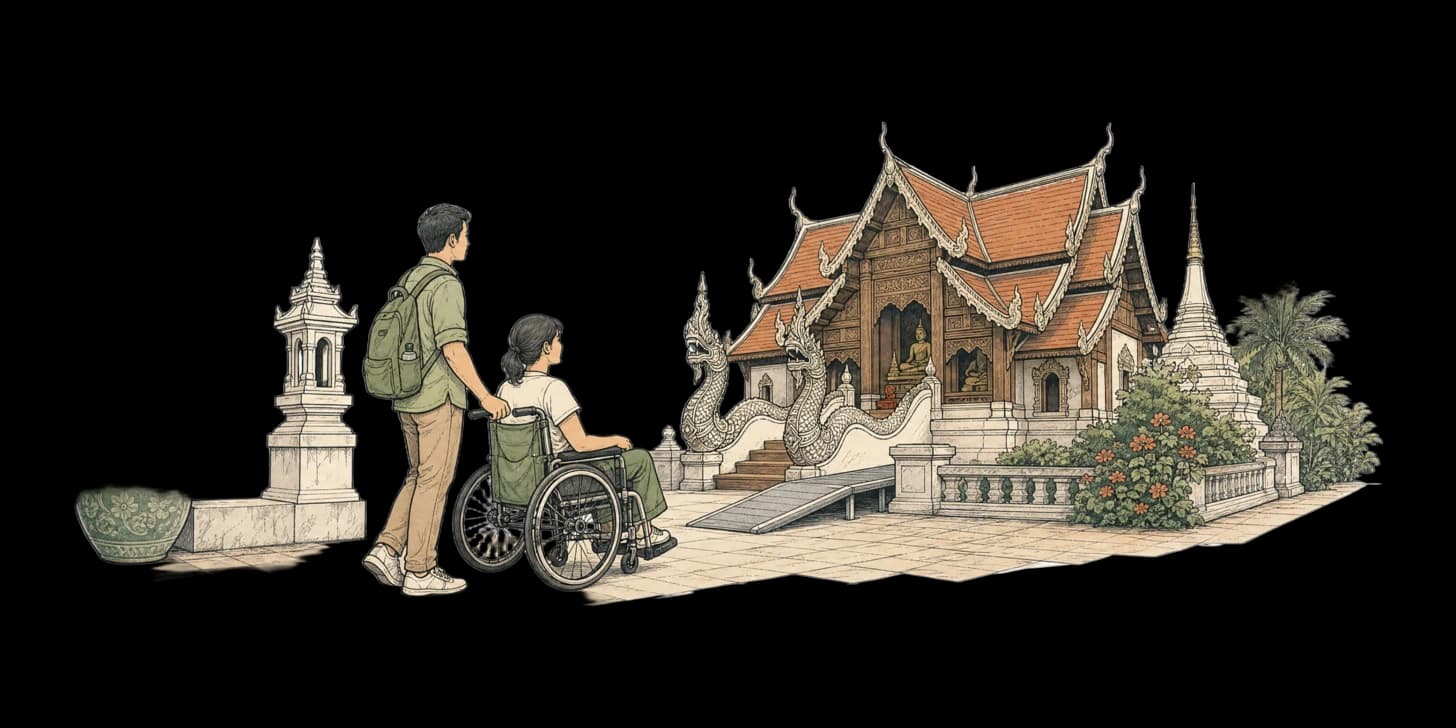
Here is the thing the infrastructure statistics never capture: Thai people help, readily and without fuss. Staff will carry a chair up a step before you have finished asking. Strangers move scooters out of your path. Drivers fold, lift and load without a sigh. Nobody makes a production of it, which is its own kind of grace. You cannot rely on the pavements in Chiang Mai — but you can, more than in most places we know, rely on the people.
Kit, planning and one last word
A little kit goes a long way. A lightweight folding ramp turns one-step cafés into open doors; a good seat cushion takes the sting out of rough surfaces; manual-chair users should pack spare tubes and basic tools. Before you fly, spend an evening in the accessible-travel forums and Facebook groups where wheelchair travellers share recent, first-hand reports — conditions change, and lived experience beats any listing. And should you need it, the city's private healthcare is excellent and used to international patients.
Chiang Mai will make you work harder than a purpose-built city ever would. It will also hand you golden temples, mountain views, river light and everyday kindness in return. Harder is not impossible — and this city rewards the effort.
Frequently asked questions
Is Chiang Mai wheelchair accessible?
Honestly: only partly. The Old City's pavements are uneven, kerbs are high and dropped kerbs rare, so wheeling around it is hard work. But modern malls, recent hotels with accessible rooms, Grab cars and flat attractions like Royal Park Rajapruek make the city very doable with realistic expectations and some advance planning.
How do wheelchair users get around Chiang Mai?
Grab cars are the practical answer — inexpensive, door to door, and most drivers will happily stow a folded chair if you message them after booking. Songthaews and tuk-tuks involve a high step up, and as far as we can tell there is no wheelchair-adapted public transport, so plan your days around private cars.
Can I visit Doi Suthep without climbing the 306 steps?
Yes. A covered funicular-style lift runs beside the famous naga staircase for around 20 baht on top of the foreigner entry fee, and the upper terrace is mostly level. Reports differ on how step-free the lift stations are, so go with a companion, ask staff on arrival and check the lift is running that day.
Which Chiang Mai temple is easiest with a wheelchair?
Wat Phra Singh is the best choice in the Old City: its broad compound is largely flat and paved with room to move between the halls, though a few buildings still have steps at the threshold.
Is Royal Park Rajapruek suitable for wheelchair users?
It is one of the easiest full days out in Chiang Mai: flat, paved paths through the gardens, a hop-on hop-off tram included in the ticket that loops every fifteen to twenty minutes, and wheelchairs available to hire at the entrance.
What should a wheelchair user pack for Chiang Mai?
A lightweight folding ramp for one-step café entrances, a good seat cushion for rough surfaces, and spare tubes and basic tools if you use a manual chair. Also book accessible hotel rooms ahead and ask for photos of the bathroom and entrance — 'accessible' means different things at different properties.