Local culture · June 27, 2026
The white elephant that chose the mountain
By The Ada House team
Some mornings, when the mist is still pooled in the valley, you can look up from the garden and catch the gold of the temple taking the first light on the mountain. We never quite get used to it. And every time, we find ourselves thinking of the story the people of Chiang Mai have told for centuries — the one about an elephant who climbed that slope long before there was a road, a staircase, or any of us here to watch. Legend has it the mountain didn't choose itself at all. An elephant chose it.
A relic that would not stay still
The story begins, as the old ones do, with something sacred. A wandering monk named Sumana is said to have carried a holy relic of the Buddha north into the Lanna Kingdom — a small fragment of bone, the most precious thing a kingdom of that age could hope to hold. To understand why a single shard of bone could move a king to build on a mountaintop, it helps to know a little about the place relics hold in Thai Buddhism: they are not mere objects but living centres of merit, drawing pilgrims, blessing, and protection to wherever they rest.
When the relic reached Lanna, the tale takes a turn into the miraculous. As it was unwrapped, the relic is said to have split clean in two — one piece glowing brighter than the other. The smaller was enshrined down in the city, at Wat Suan Dok, where it remains. But the second piece left everyone uncertain. A relic this powerful could not simply be tucked into any temple. It would have to be given ground worthy of it. The only question was where.
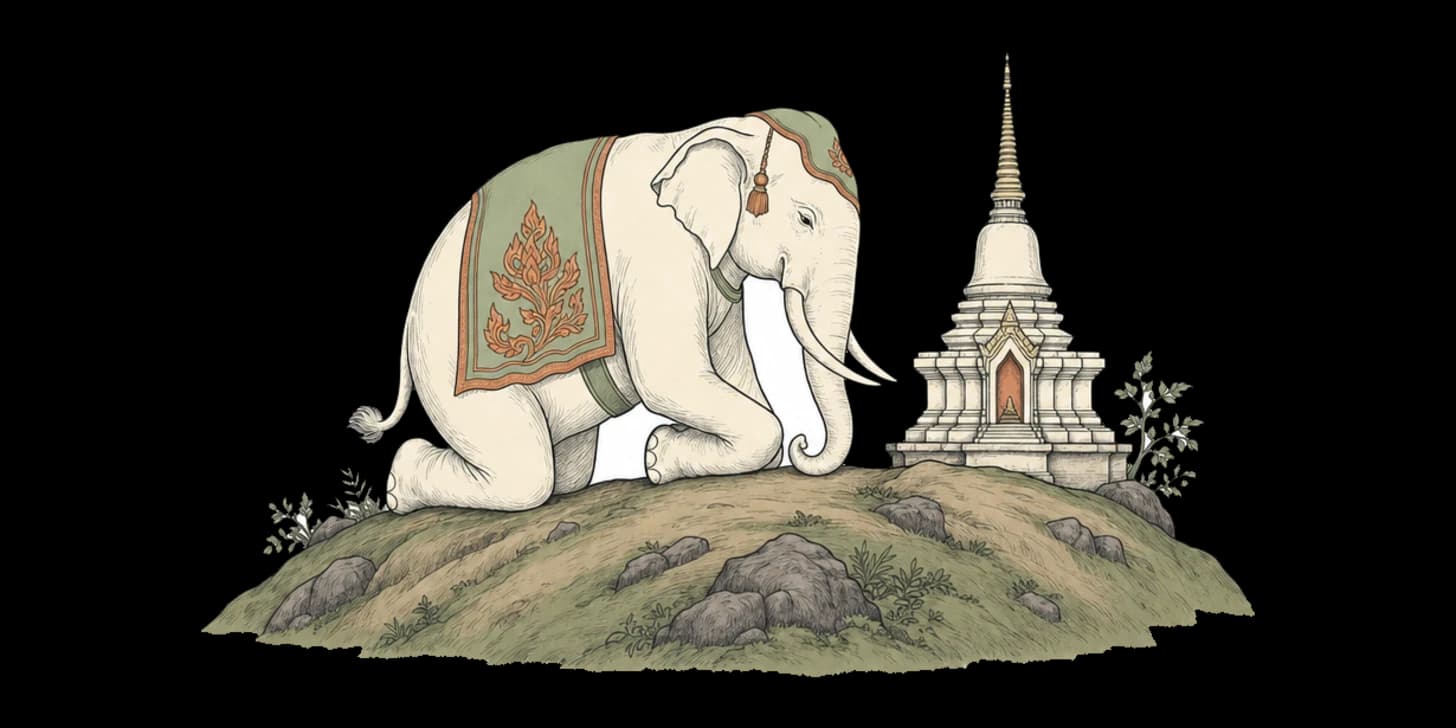
The king and the sacred elephant
That question fell to King Kuena, who ruled Lanna from its glittering capital in the fourteenth century — a golden age you can read more about in our short history of the Lanna Kingdom that built Chiang Mai. Rather than choose the spot himself, the king did something we still find rather beautiful: he decided to let the relic choose its own home.
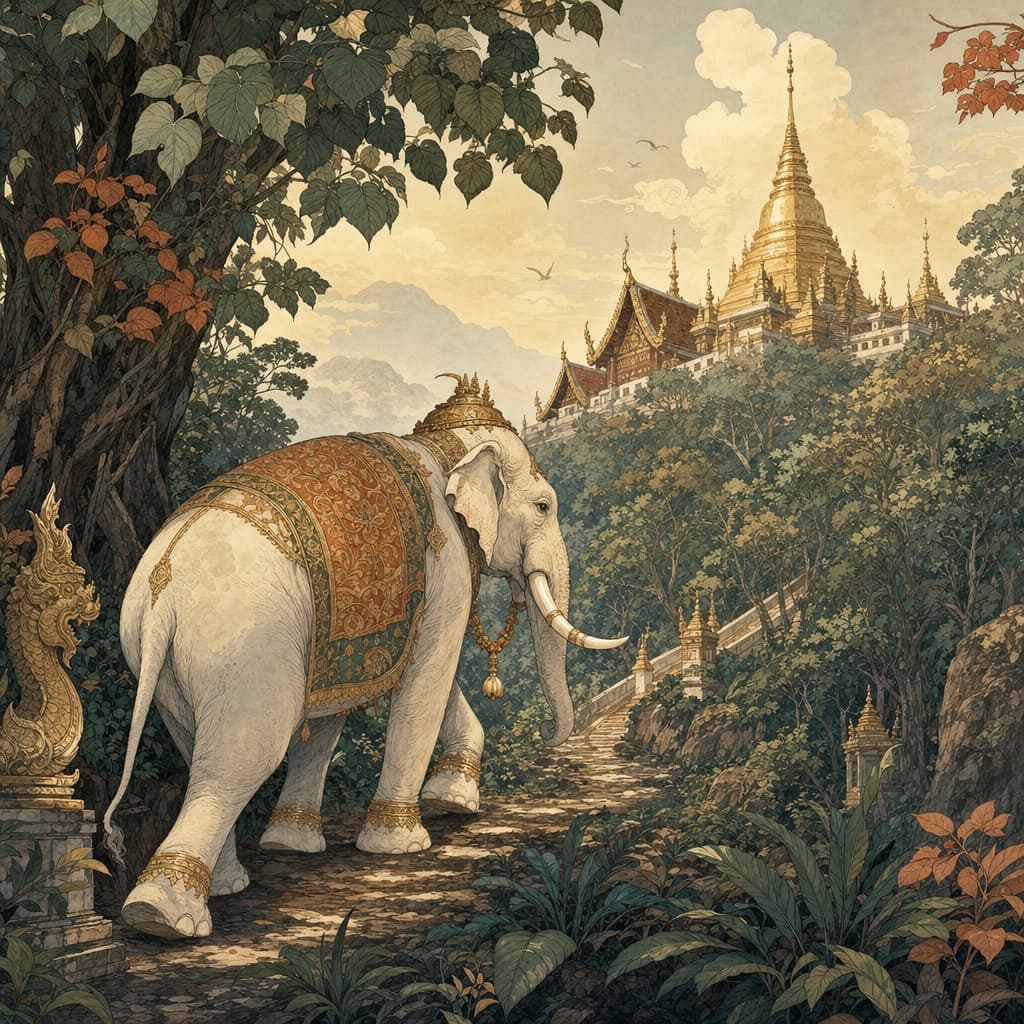
He had the precious fragment placed inside a small portable shrine and lifted it onto the back of a sacred white elephant. Then, before a gathered crowd, the elephant was set free — no rider, no rope, no direction given. Wherever the animal wandered, the court would follow, trusting that some older wisdom than theirs was steering it.
The climb, the three trumpets, the kneeling
The elephant turned its back on the comfort of the city and, to everyone's astonishment, began to climb. It crossed the plain, pushed into the forest on the western flank of the mountain, and started up — higher and higher, the courtiers scrambling behind, the slope steepening with every hour. The story goes that it did not stop to rest, did not turn for home, but climbed as though it knew exactly where it was bound.
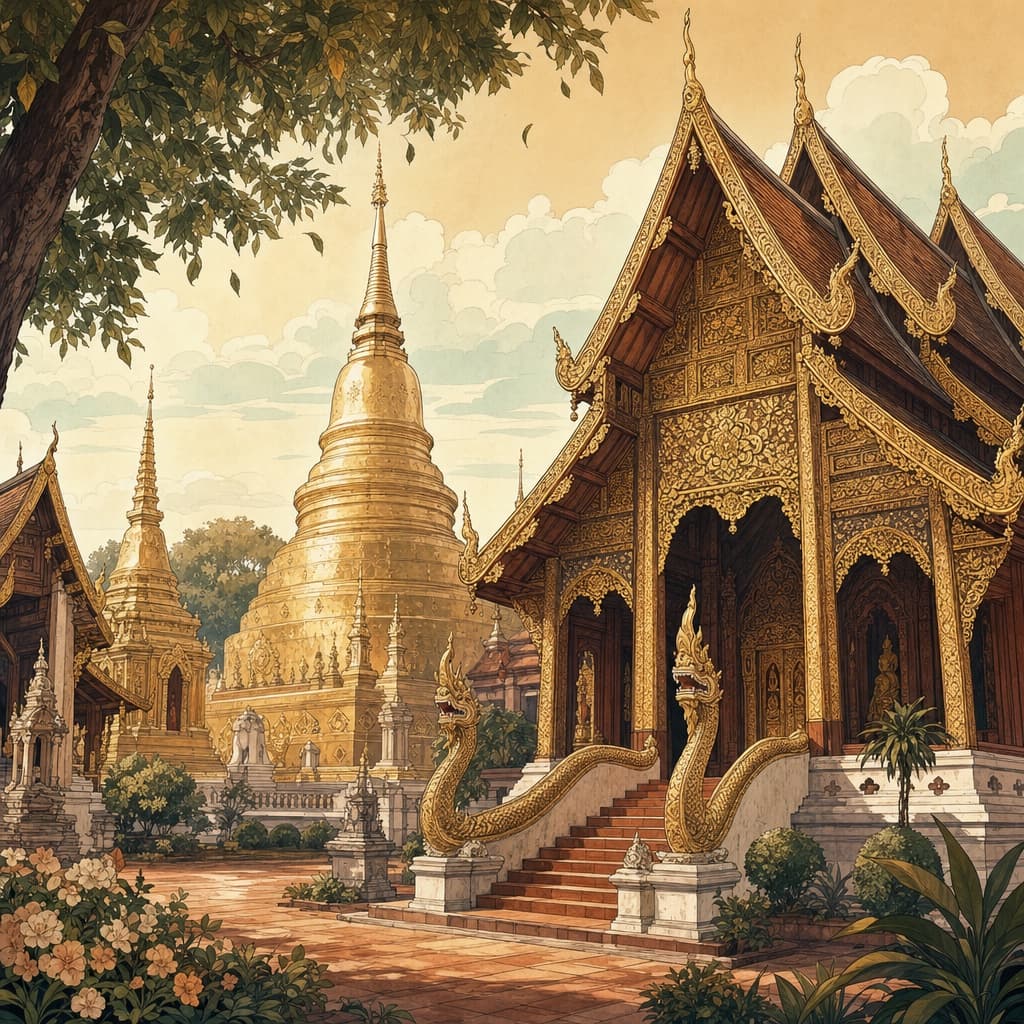
Near the summit, it finally halted. There, the legend says, the white elephant trumpeted three times, turned itself around three times, knelt slowly to the ground — and died. The watching court took it as the clearest of omens. This was the spot the relic had chosen for itself. And here, on this very ground, King Kuena ordered the building of the temple we now know as Wat Phra That Doi Suthep, its golden chedi raised over the place where the elephant came to rest.
Why a white elephant?
It is no accident that the story turns on a white elephant rather than any other creature. In the Lanna world, and across Thailand still, the white elephant is the most royal and most sacred of animals — a living symbol of kingship, merit and good fortune, so revered that the rarest were traditionally presented to the king himself. To entrust the relic to such an animal was to place it in the hands of heaven. An elephant that climbed a mountain and knelt was not a curiosity. It was a sign no one in the kingdom would dare to argue with.
A mountain that still watches over us
Centuries on, that sign still shapes daily life here. Wat Phra That Doi Suthep is the most revered temple in northern Thailand, and locals will gently tell you that you haven't truly known Chiang Mai until you've climbed up to greet it. Pilgrims come to walk three times around the golden chedi, just as the elephant circled before it knelt — a small echo of the legend, repeated by thousands of hands and feet across the years.
And the loveliest part: you can step straight into the story yourself. The temple is reached by a great Naga staircase, its twin serpents pouring down the mountainside, more than three hundred steps that pilgrims have climbed for generations. If you'd like to make a morning of it, we've laid out exactly how we'd do it in our guide to a weekend at Doi Suthep.
Climb it slowly. Somewhere near the top, when the city opens up below you and the gold catches the light, it's easy to believe an elephant once stood right here and decided this was the place. We rather like believing it too.
See you on the staircase — we'll save you the view.
Frequently asked questions
What is the legend of the white elephant?
The story tells of a sacred white elephant carrying a holy Buddha relic, set free by King Kuena to choose its own resting place. It climbed Doi Suthep, trumpeted three times, turned itself around three times, knelt and died, and on that very spot the temple was built.
Which temple did the legend give rise to?
Wat Phra That Doi Suthep, whose golden chedi was raised by King Kuena over the place where the elephant came to rest. Centuries on, it remains the most revered temple in northern Thailand.
Why was it a white elephant in the story?
In the Lanna world, and across Thailand still, the white elephant is the most royal and most sacred of animals, a living symbol of kingship, merit and good fortune. To entrust the relic to such an animal was, in the tale, to place it in the hands of heaven.
How do I reach the temple?
The temple is reached by a great Naga staircase, its twin serpents pouring down the mountainside, more than three hundred steps that pilgrims have climbed for generations. Climb it slowly, and near the top the city opens up below you.
Is there a custom to follow at the chedi?
Pilgrims walk three times around the golden chedi, just as the elephant circled before it knelt. It is a small echo of the legend, repeated by thousands of hands and feet across the years.