Local culture · June 27, 2026
The naga: the serpent that guards every temple
By The Ada House team
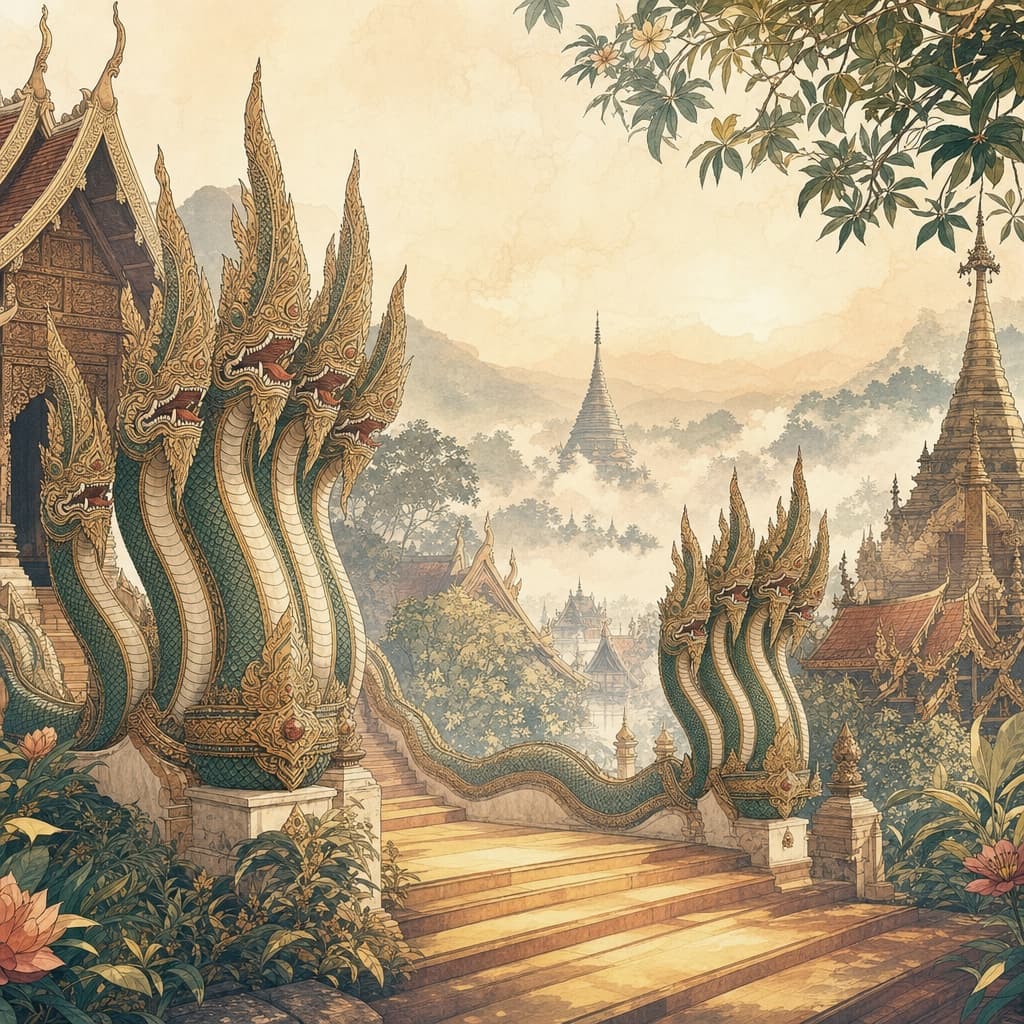
There is a small, almost secret moment that happens every time you visit a temple in Chiang Mai. You reach out, usually without even looking, and rest your hand on the railing as you start up the steps. That railing is scaly. Its body ripples the whole length of the staircase, and at the very bottom it rears up into a fanged, many-headed face. You have, quite cheerfully, been holding hands with a god.
That god is the naga - in Thai, Phaya Nak - and once someone points it out to you, you cannot un-see it. So consider this our pointing.
The creature you have been touching all along
The naga is a great serpent of Buddhist and wider Southeast-Asian myth: a divine, half-snake being that lives in rivers, lakes and the watery underworld, guarding treasure and presiding over the rain. It is benevolent, powerful and a little fearsome - the sort of guardian you very much want on your side.
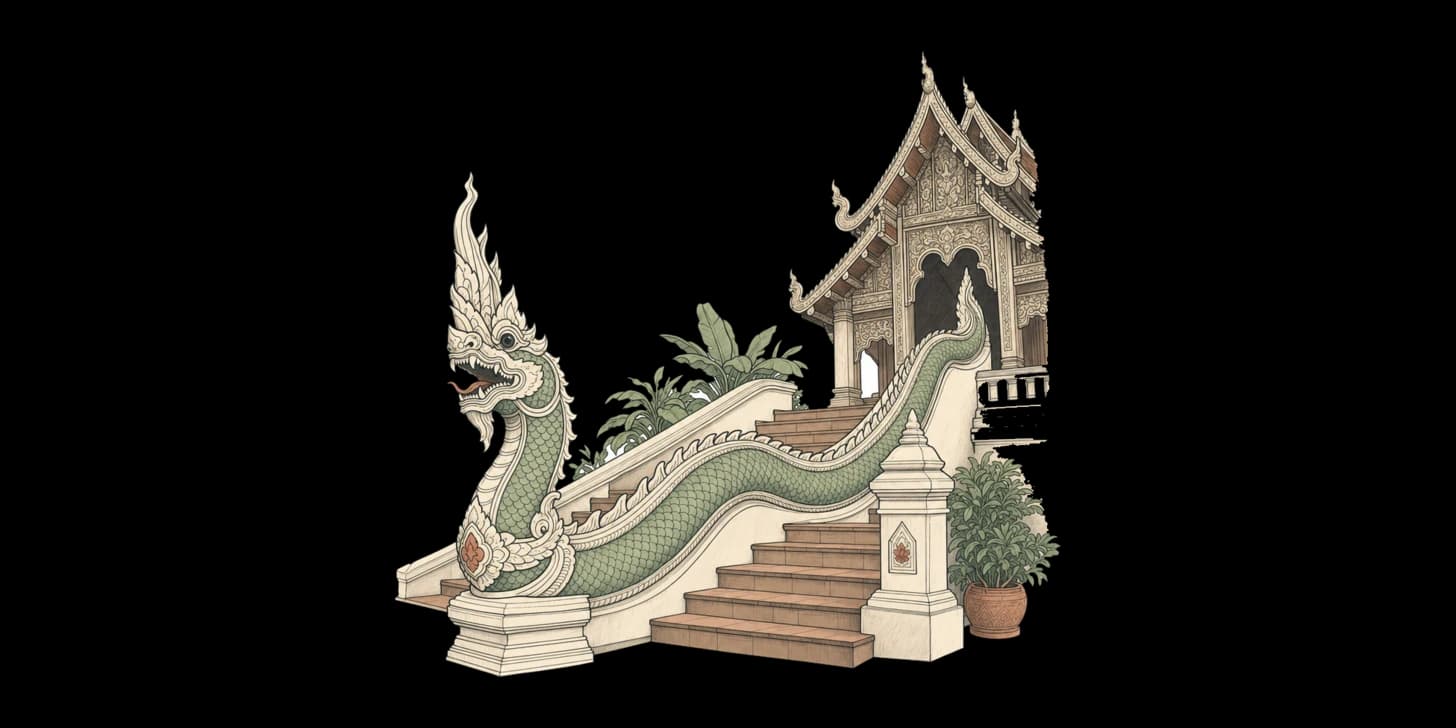
And it is genuinely everywhere. Those long balustrades flanking temple staircases are naga bodies, their heads flared at the foot of the steps. The graceful, horn-like curls rising from the ends of temple roofs are stylised naga forms too. Wander the lanes of the old city and its clustered temples for an afternoon and you will pass dozens of them - at Wat Phra Singh, at Wat Chedi Luang, at the little neighbourhood wats nobody photographs. We promise you will never walk past one again without noticing.
The storm, the Buddha, and seven coils
The naga earns its place at the temple door from one of the gentlest stories in Buddhism. Shortly after his enlightenment, the Buddha sat in deep meditation as a great storm rolled in - seven days and seven nights of wind and rain. A naga king named Mucalinda rose up from beneath the earth, coiled his body seven times to lift the Buddha clear of the rising water, and spread his many hooded heads overhead like a living umbrella.
When the skies cleared, the naga unwound, took the form of a young man, and bowed. That is the image you will see again and again across the city: the Buddha seated serenely on a coil of serpent, a fan of cobra-like heads arching protectively behind him. It is one of the warmest ideas in the tradition - that the wild, watery power of nature chose, of its own accord, to shelter stillness.
Water, rain, and the bridge between worlds
So the naga is, above all, a guardian of water - of rivers, monsoon rain, fertility and the harvest that follows. In a region that has always lived and died by the timing of the rains, that makes it one of the most important figures of all, a thread running deep through the everyday fabric of Thai Buddhism.
The staircase is where the symbol becomes something you can walk. The naga's tail begins up at the temple terrace, in the realm of the sacred; its head waits down at street level, in the ordinary human world. As you climb between the two serpents, you are travelling the serpent's own body - a bridge between earth and the heavens, from the everyday up to the divine. The next time the steps leave you a little breathless, take some comfort: you are not just climbing, you are crossing over.
Fireballs on the Mekong
The naga's true home is the Mekong, the great river curling along Thailand's north-eastern edge, and the lore there runs even deeper. Once a year, around the end of Buddhist Lent in October, locals gather on the banks to watch glowing red orbs rise silently from the water and vanish into the night sky - the famous naga fireballs, understood as the serpent's offering to the Buddha. Villages still speak of naga-blessed people, of ordination processions led by serpent imagery, of rivers whose very course was carved by a naga gliding to the sea. Myth here is not a museum piece. It is alive, and it is local.
How to read a naga
Now for the fun part - reading them yourself. Pause at the foot of the next staircase and count the heads: you will often find an odd number, five or seven, echoing Mucalinda's hoods. Notice whether the naga emerges cleanly or pours out of the gaping mouth of a makara, a sea-monster that frequently spawns it. Then look up: those flame-like finials along the roofline are naga tails reaching for the sky.
For the full spectacle, few places beat the rainbow-tiled, mirror-bright staircases of Wat Ban Den, an hour or so north of us - a whole temple complex where the serpents are the show. Go, run your hand along that scaly railing, and say a quiet hello.
May your stairs always be guarded - see you back at the house.
Frequently asked questions
What is the naga?
The naga, in Thai Phaya Nak, is a great serpent of Buddhist and wider Southeast-Asian myth: a divine, half-snake being that lives in rivers, lakes and the watery underworld, guarding treasure and presiding over the rain. It is benevolent, powerful and a little fearsome, the sort of guardian you very much want on your side.
Where will I see the naga around temples?
Genuinely everywhere, once you spot it. The long balustrades flanking temple staircases are naga bodies, their heads flared at the foot of the steps, and the graceful horn-like curls rising from temple roofs are stylised naga forms too. Wander the old city for an afternoon and you'll pass dozens, at Wat Phra Singh, Wat Chedi Luang and the little neighbourhood wats.
Why is the naga linked with the Buddha?
It comes from one of the gentlest stories in Buddhism. Shortly after his enlightenment, the Buddha meditated through a storm of seven days and nights, and a naga king named Mucalinda rose up, coiled his body seven times to lift the Buddha clear of the rising water, and spread his many hooded heads overhead like a living umbrella. You'll see this image of the Buddha seated on a coil of serpent again and again.
What does the naga symbolise?
Above all it's a guardian of water, of rivers, monsoon rain, fertility and the harvest that follows, which makes it hugely important in a region that has always lived by the timing of the rains. On a temple staircase the naga also forms a bridge between earth and the heavens: its tail begins at the sacred terrace and its head waits at street level, so climbing the steps means travelling the serpent's own body.
What are the naga fireballs?
The naga's true home is the Mekong, and once a year, around the end of Buddhist Lent in October, locals gather on the banks to watch glowing red orbs rise silently from the water and vanish into the night sky. These famous naga fireballs are understood as the serpent's offering to the Buddha.
How can I read a naga myself?
Pause at the foot of a staircase and count the heads; you'll often find an odd number, five or seven, echoing Mucalinda's hoods. Notice whether the naga emerges cleanly or pours from the gaping mouth of a makara, a sea-monster that often spawns it, then look up at the flame-like roof finials, which are naga tails reaching for the sky.